
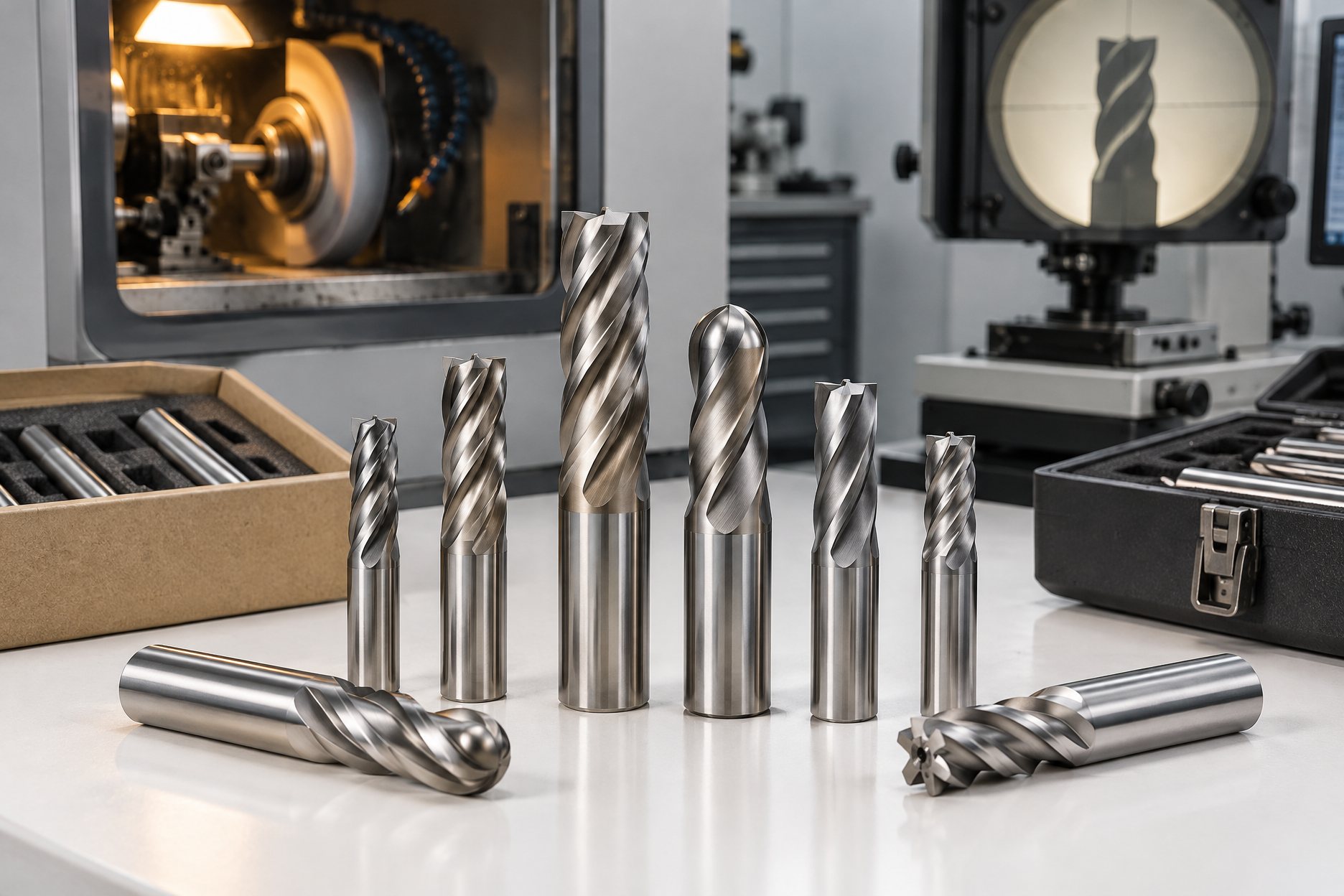
Who still buys high-speed steel
Solid carbide took over CNC production milling, and the trade sometimes talks as if HSS left with it. It did not. A steady share of milling still happens at spindle speeds and rigidity levels where high-speed steel is the sensible choice: maintenance benches, repair shops, older knee mills, hand-held machines used on site, and education programs that buy by the class set. For those buyers the question is not which substrate wins on a datasheet; it is which one survives the way their people actually work. That is what this page covers - where HSS end mills genuinely win, where they lose against carbide, and what to put on the spec sheet when HSS is the answer.
The substrate: HSS and HSS-Co
High-speed steel is a tool-steel family alloyed to keep working hardness at cutting temperatures. The common upgrade adds cobalt, known in the trade as HSS-Co or HSS-E. Cobalt raises hot hardness and wear resistance, so a cobalt grade holds its edge longer in harder and gummier materials while keeping the toughness that defines the family. Neither version approaches solid carbide for hardness or stiffness, and that is not its job: HSS bends a little where carbide would chip, and it sits lower on the cost ladder per tool. Which grade a program runs - straight HSS or a cobalt grade - is a spec-sheet line, confirmed by the producing factory in writing. The cobalt difference has its own note: what cobalt changes.
Four situations where HSS beats carbide
First, rigidity-limited machines. An older mill that cannot spin the surface speeds modern coatings are built for gets little of carbide's benefit and all of its brittleness; HSS cuts happily at low rpm. Second, hand-held and on-site work. A tool that meets a clamp bolt or an interrupted edge while the operator's hands move needs toughness more than hardness. Third, interrupted cuts in general - slotting into scale, milling a weld, opening a seized assembly - where a chipped edge ends the shift but a dulled HSS edge keeps going. Fourth, the economics of breakage: in maintenance environments where tools get lost and occasionally destroyed, a substrate that bends before it shatters is often the honest choice for the budget. The full comparison is worked through in the carbide vs HSS note.
The trade-offs, stated plainly
The honest list. HSS is less stiff than carbide, so it deflects more at a given reach - expect that in long cuts and thin-wall work. It tolerates less heat, so surface speeds run lower; pushing HSS at carbide speeds burns the edge. It wears faster in production work, so parts per edge are fewer. What it gives back: it chips less readily, it survives imperfect setups, and a broken tool costs less to absorb. On this site the line stays the same everywhere: match the substrate to the machine and the work, not to fashion. Carbide remains the default for CNC production, and the solid carbide range sits next to HSS in the same catalog rather than replacing it.
| Property | HSS / HSS-Co | Solid carbide |
|---|---|---|
| Stiffness | Lower; more deflection at reach | High; holds geometry under load |
| Heat tolerance | Lower; conservative surface speeds | High; built for coated, faster cutting |
| Failure mode | Dulls and bends before it shatters | Chips at the edge under abuse |
| Natural place | Maintenance, older machines, hand-held work | CNC production on metals |
| Cost position | Economy substrate per tool | Higher per tool, longer production life |
Geometries available in HSS
Nearly every general-purpose family the desk coordinates exists in HSS, and a few are traditionally HSS territory. Square end mills in two and four flutes carry slots, profiles and general milling. Ball nose tools serve contour and repair work. Roughing end mills clear metal quickly where the setup rattles. Slot drills - center-cutting tools for plunging and keyway work without a pre-drilled hole - are a classic HSS format and a staple of maintenance counters. Chamfer mills, corner rounding profiles and tapered geometry round out the range. Flute counts follow the usual trade logic: two flutes for chip room in soft, gummy materials; four for steels and finishing; higher counts where feed potential matters in harder materials. Each line is confirmed on the spec sheet before quoting, with the reasoning laid out in the site's flute count guide.
Coatings for a tough substrate
HSS takes coatings well. TiN, the gold general-purpose family, is the traditional finish and a sensible default for mixed maintenance work. Where heat builds up - steels, heavier feeds, dry running - the TiAlN family is available and follows the same logic it does on carbide. Many HSS programs still run uncoated where economy leads and the work is soft. Coating is a spec-sheet line rather than a catalog assumption: name the family you want, or ask the desk to propose one against your material list, and it is confirmed in writing before grinding starts. Coated or bare, the choice is recorded on the sheet the bulk run is checked against.
Packing, marking and program shape
HSS programs pack like the rest of the desk's output: closed boxes with the tools separated and geometry labeled - commonly ten pieces per box, one geometry per box - inside cartons kept dry in transit. Distributors usually start with neutral boxes; under the OEM route, your logo is laser-marked on the shank and printed on the labels, with standard geometry carrying your mark typically starting from about 50 to 100 pieces per specification. The reference rhythm matches the rest of the desk: samples for ground-to-order tools in about 15-25 days, bulk about 30-45 days after approval, coating a few days over uncoated where a program calls for it. The numbers and their conditions sit on the MOQ and lead time page; everything else is quoted per program through the quote form.