
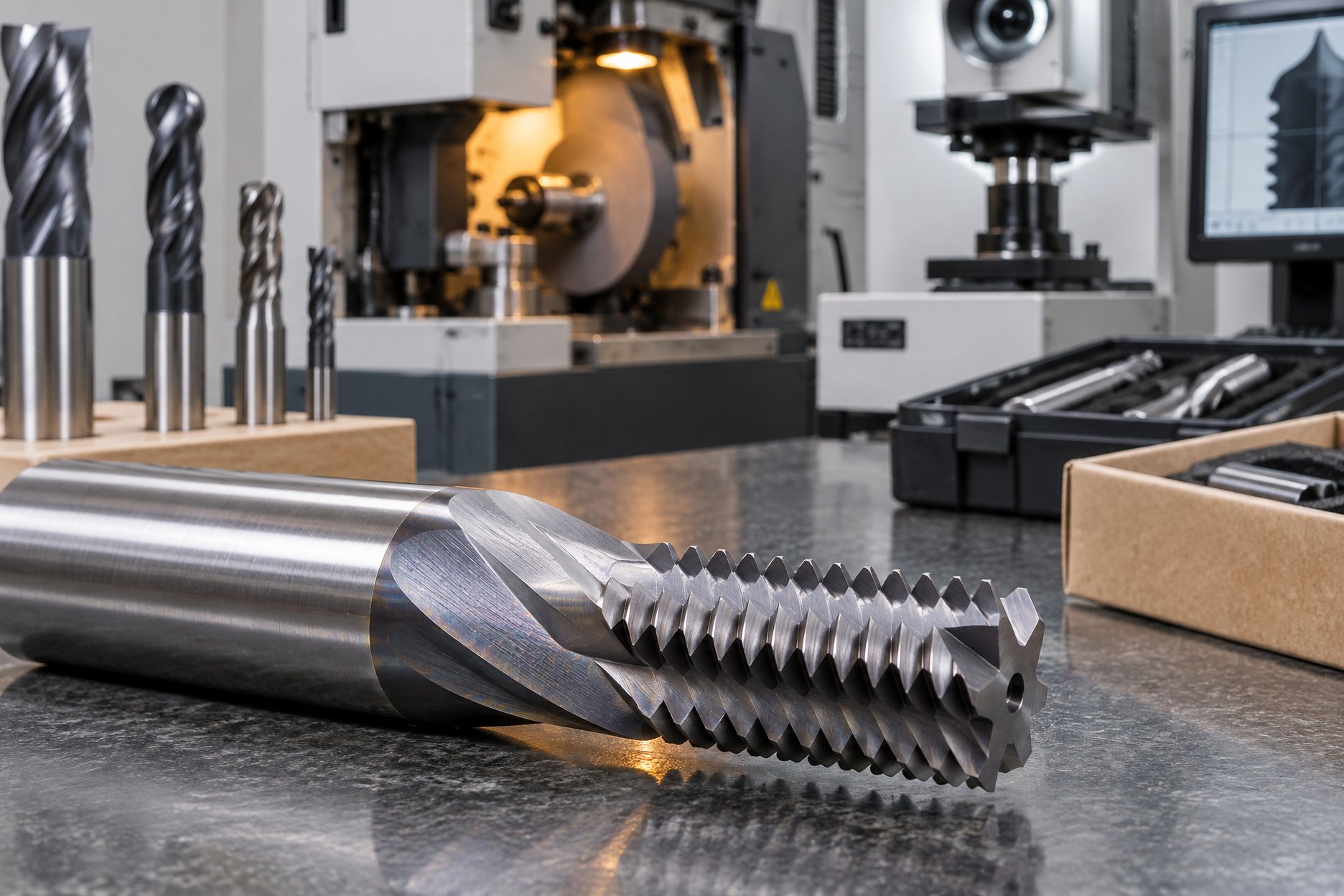
The thread the machine writes
Threading a hole usually means a tap: a tool with the full thread form that cuts as it screws in. A thread mill works differently. The cutter carries the thread profile on its periphery, but the helix - the spiral of the thread - is written by the machine's motion, a helical interpolation that combines circular movement with axial feed. The tool provides the form; the control provides the spiral. That division of labor is the source of every advantage and every caveat in thread milling, and it is why the technique lives on CNC machining centers and has no place yet on machines without interpolation.
Single profile, full profile
Two cutter families cover the work. A single-profile thread mill carries one row of profile teeth; it travels around the hole and climbs, revolution by revolution, building the thread to full depth over several interpolated passes. A full-profile thread mill carries the complete thread form along its length, and one 360-degree pass cuts the entire thread at once. Single-profile tools are flexible across depths and unusual forms; full-profile tools are fast where the form is standard. Both cut to size by path rather than by a fixed tool dimension - the machine adjusts the interpolated radius, and the thread comes out right.
One cutter, many hole diameters
Here is the practical consequence. The pitch is built into the cutter's profile - that is fixed. But the diameter of the finished thread is produced by the interpolated path, so one cutter near its pitch covers a diameter range: the same tool threads an M10 and an M12, or their inch equivalents, by changing the programmed radius. For a maintenance shop or a job shop with unpredictable work, that collapses the thread-tool drawer from a size-per-size rack to a short pitch-indexed set. Exact coverage per cutter - the range of thread sizes it produces at its pitch - is confirmed on the spec sheet per line, in the same discipline as any other dimension on the sheet; see the spec sheet template note.
Why buyers switch, and what they weigh
| Consideration | Thread milling | Tapping |
|---|---|---|
| Failure mode | A broken mill is retrievable; the part usually survives | A broken tap in an expensive part can scrap it |
| Diameter flexibility | One full-profile cutter covers a range at its pitch | One tap per size |
| Size control | Adjusted by the programmed path | Fixed by the tap |
| Machine demand | Needs helical interpolation and a rigid setup | Runs on simpler controls |
| Cycle time in mass production | Often longer | Often shorter |
The first row is why the switch usually happens: on a housing that has been machined for hours, a snapped tap is the most expensive tool break in the shop, and broken-tool postmortems are cheaper to avoid than to run. The last two rows are why thread milling has not replaced tapping everywhere: high-volume work with predictable sizes still belongs to the tap, and a shop without interpolation capability has no choice to make yet. Both statements belong in any honest buying conversation.
Where the family fits
Thread milling suits blind holes where a tap's chip jam is the risk, large diameters where tap torque is uncomfortable, parts that must not rotate or where chip evacuation is poor, threads in difficult materials, and the interrupted or unfinished holes that real machining produces. It is also the tolerant method: threads cut by interpolation can be corrected by a second pass with an adjusted radius, which is a repair strategy as much as a cutting strategy. Job shops and mold shops discover this family by problem, then keep it for range.
Substrate, coating, and the material angle
Solid carbide is the common substrate, fine-grain for edge strength at the small diameters thread mills live at; HSS forms persist in maintenance work. Coating follows the workpiece: the TiAlN family for steels and stainless, TiN for general purpose, uncoated polished where aluminum dominates - the families are compared in the coating comparison. Stainless thread work, with its work-hardening habits, is a recurring request, and the material-side notes live on the stainless page. Coating and substrate lines are confirmed per program, like every other line on the sheet.
What the spec sheet names
| Profile | Single-profile or full-profile |
|---|---|
| Pitch / form | The thread the profile produces; confirmed per spec |
| Thread size range | Diameters covered at that pitch, confirmed per spec |
| Cutter diameter | Must clear the minor diameter of the smallest thread |
| Thread length / LOC | How deep the form reaches |
| Shank, coating | Holder fit; TiAlN family, TiN, uncoated polished |
Standard pitches or your program
Standard pitch families in the common range are catalog items, boxed and quoted per line. Custom forms - special pitches and trapezoidal profiles within the family's capability, taper threads - go the OEM route with a drawing: your geometry, your marking, samples about 15 to 25 days after the drawing is agreed, bulk about 30 to 45 days after approval, quantities from around 50 to 100 pieces per specification for standard geometries. All reference figures, confirmed in writing per program; the MOQ and lead time page holds the table. If you are building a thread-milling range under your own brand, send the pitch list and market with the quote form - the desk will answer with the route, the spec sheet and the lines still open.