
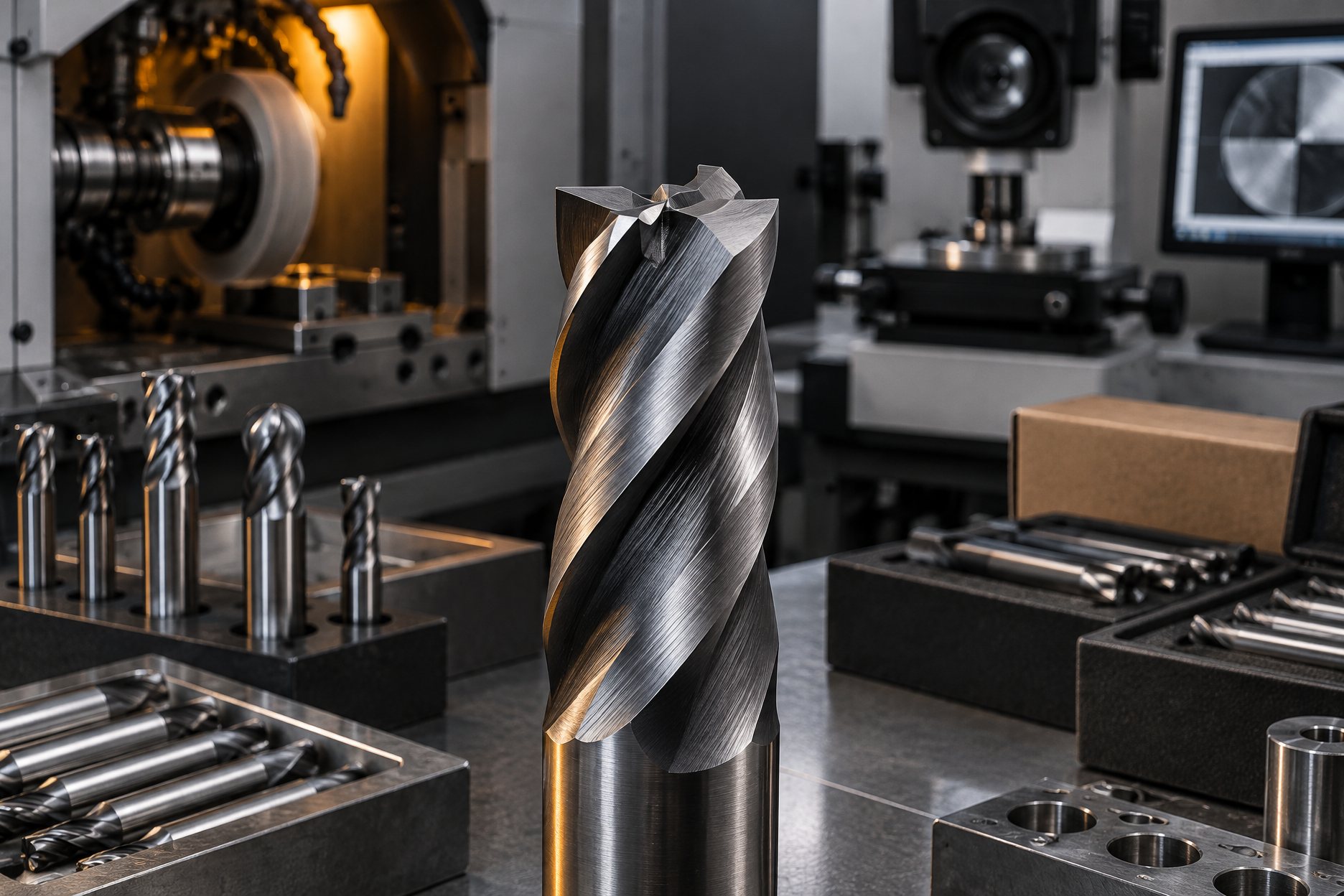
What a square end mill is
A square end mill is a rotary cutter with cutting edges on two surfaces: the periphery and the face. The corner where those surfaces meet is sharp - a clean 90 degrees. That single feature is the identity of the family: it cuts a flat floor, a square shoulder and a slot with vertical walls in one pass, and it leaves an inside corner in the part exactly as sharp as the tool itself. It is the most general-purpose end mill geometry there is, which is why most tooling ranges start here. Like any end mill it is distinct from a drill bit: it cuts sideways as well as down, and it only plunges into solid material when the face edges meet at the center - the center-cutting question covered around slot drills and in this note.
Where the sharp corner earns its keep
Three jobs keep square end mills in the spindle. Slots: a slot of a given width is cut in one or two passes with a tool of that diameter, and the walls come out square because the corners are. Shoulders: when a step in the part must meet its floor at 90 degrees, a sharp corner is the only geometry that produces it. Profiles: tracing a contour around a part leaves square internal corners wherever the path turns. Then there is the mating case that decides many purchases. If the part will later carry a square insert, a key, or another component with a sharp internal corner, the pocket that receives it needs a sharp corner too. A radiused tool physically cannot cut one, no matter how clever the tool path is - which is why "what does the print allow at the corner" is the first question on this family.
Sharp corner or corner radius: the honest trade-off
The same sharpness that makes square geometry useful is also its weak point. The corner between periphery and face is the thinnest, most exposed part of the cutting edge, and in shoulder work it takes the brunt of the load. On abrasive or harder alloys that corner wears first, and a chipped corner shows up immediately as a burr or an undersized step. That is exactly why the bull nose end mill exists: it puts a radius into that corner so the load spreads along an arc instead of concentrating on a point. The buyer's decision is therefore not which tool is better in the abstract, but what the part allows. If the drawing gives an internal corner radius allowance, take it - the radius tool holds its edge longer on harder materials. If the drawing demands a sharp 90-degree corner, the square end mill is the only tool that cuts it, and the program should budget for corner wear accordingly.
| Question | Square end mill | Bull nose (corner radius) |
|---|---|---|
| Internal corner in the part | Sharp 90 degrees | Radius equal to the tool radius |
| Floor-to-wall junction | Knife-sharp; can raise a burr on some materials | Blended by the radius |
| Corner strength of the tool | Thinnest section of the edge | Load spread along an arc |
| Best fit | Slots, sharp shoulders, mating features | Harder alloys where a radius allowance exists |
Geometry facts at a glance
| Line | Standard description |
|---|---|
| Cutting edges | On the periphery and the face; cuts laterally, plunges when center-cutting |
| Corner | Sharp, 90 degrees between periphery and face |
| Flutes | 2 for chip room in aluminum and deep slots; 3 a common aluminum compromise; 4 suit steel and finishing; confirmed per spec sheet |
| Helix | Around 30 degrees is a general-purpose default; high-helix shears better in aluminum; low or straight flutes reduce lifting on thin walls |
| Substrate | Fine-grain tungsten carbide standard; HSS and HSS-Co for toughness and economy |
| Coating | TiAlN family for steels and dry work; TiN general purpose; uncoated polished flutes for aluminum |
Each of those lines has a page behind it - the flute count guide, the substrate and coating notes under carbide end mills - and the diameter and length series sit on the sizes reference.
Flute and coating choices by material
Material decides most of the sheet. In aluminum, a 2-flute or 3-flute square end mill with polished, usually uncoated flutes resists built-up edge and clears chips out of deep slots - the reasoning is on the aluminum page. In steels, four flutes with a TiAlN-family coating are the common answer, and the same logic carries into stainless with attention to work-hardening - see the stainless page. Titanium argues for rigidity, lower speeds and care at the corner, which pushes some programs toward a radius even where the print would allow sharp - the titanium page explains. Whatever the choice, it is written on the spec sheet as a line, not left to a factory's habit.
Standard route or ground to your drawing
Two ways to buy. The standard route: reference geometry in the common diameter range, boxed - commonly ten pieces per box, one geometry per box - ready to ship in days, sensible for distributors and resellers filling a catalog. The OEM route: your diameter, your flute count, your length of cut, your logo laser-marked on the shank, from quantities that start around 50 to 100 pieces per specification for standard geometry. Custom grinding samples take about 15 to 25 days after the drawing is agreed; bulk about 30 to 45 days after approval, with coating adding a few days. Every figure is a typical reference range, confirmed in writing for your program - the table on MOQ and lead time collects them.
What the desk checks before bulk
Square programs are inspected against the approved sample and the spec sheet, not against a photo: optical profile measurement of diameter and flute geometry, runout at the cutting edge, corner condition under magnification, coating appearance, marking and packing. A certificate of conformance and material certificates travel with the shipment per program. The desk's role is to make sure the sheet you approved is the sheet that ships; how the tools get made is described on the production process page.
Send the sheet
If you buy square end mills regularly, a one-page spec sheet per item - diameter, flutes, length of cut, overall length, shank, substrate, coating, quantity per line - quotes faster and reorders cleaner than any conversation. Send it through the quote form, or start from the geometry index on the products page if the range is still taking shape.