
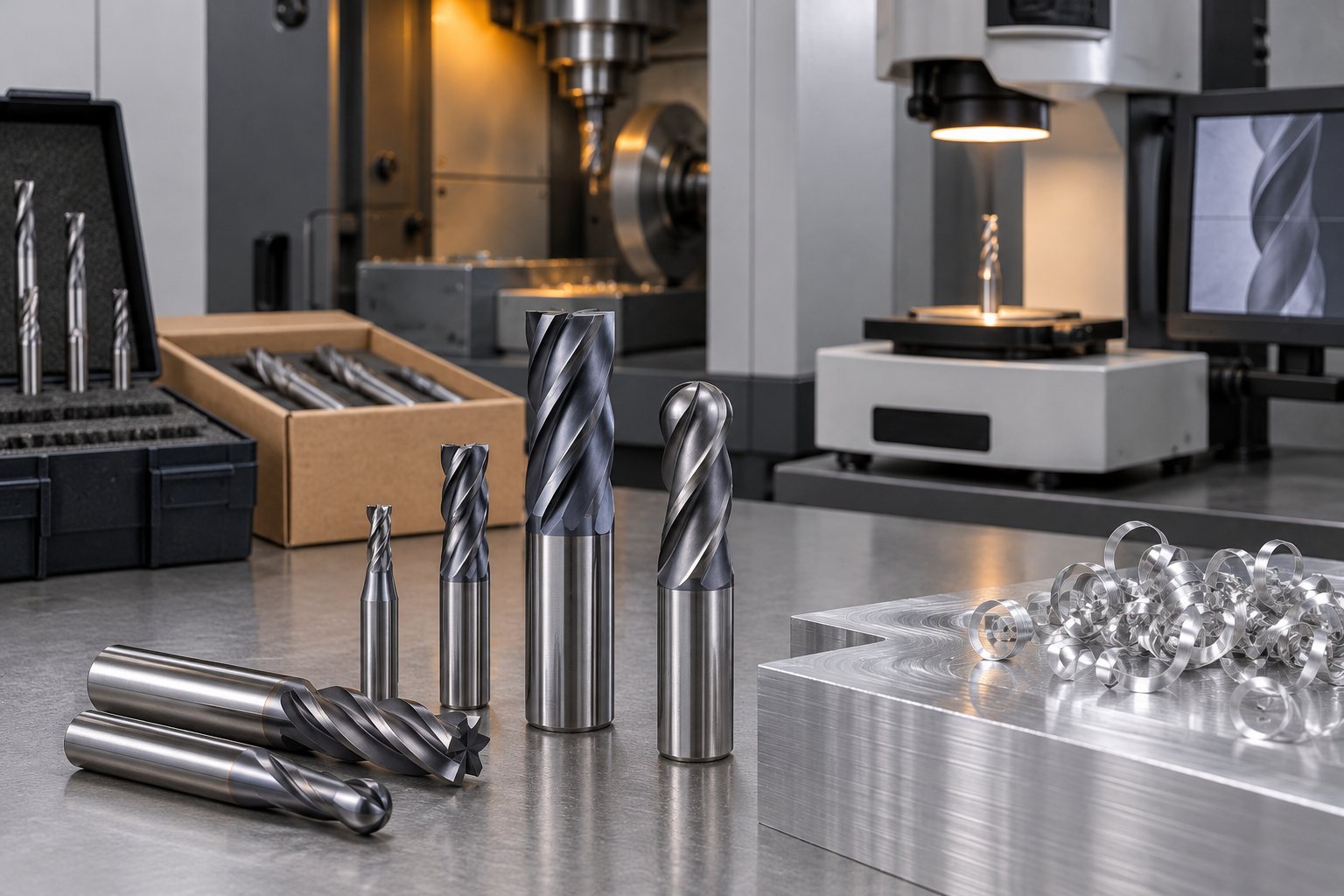
Why aluminum punishes the wrong geometry
Aluminum is easy to machine and hard on the wrong end mill at the same time. The material is soft and removes quickly, but it also likes to weld itself to a cutting edge under heat and pressure. When that happens - machinists call it built-up edge - the welded aluminum changes the effective shape of the tool, the edge stops shearing cleanly, and surface finish slides until the edge fails or the tool is replaced. Most aluminum complaints that reach this desk trace back to three geometry decisions: the coating choice, the flute count, and the helix. Get those three right for the alloy in question and the rest of the program is ordinary engineering.
The order matters, too. Buyers often arrive asking for a specific diameter first and treat everything else as detail. In aluminum the diameter is usually the least decisive line on the sheet; the flute and finish decisions are what separate a tool that runs all day from one that gums up by the second pocket. So this page works through the decisions in the order the desk writes them into a spec sheet, starting with the surface of the flutes themselves.
Polished, uncoated flutes come first
The default answer for an end mill for aluminum work is uncoated carbide with highly polished flutes. A smooth flute surface gives aluminum's sticky chips less to grab, so chips evacuate instead of accumulating and fusing to the tool. Most PVD coatings, which serve steels well, are counterproductive here: the microscopic texture and chemistry of common nitride coatings give the material more places to adhere, which is exactly the failure mode aluminum work wants to avoid. That is why the coating line on an aluminum spec sheet usually reads "uncoated, polished", and why the fuller reasoning sits in the note on uncoated end mills and aluminum.
There is one standing exception worth knowing before you spec anything: high-silicon cast alloys are abrasive rather than merely sticky, and abrasive media eat polished edges quickly. For that family of alloys the conversation shifts toward diamond-family coatings and a harder substrate call, which the note on diamond-coated end mills covers. For the broad run of wrought stock and common castings, though, polished and uncoated remains the sensible starting point - and it is the configuration most aluminum programs on this desk settle on when the samples come back.
Two or three flutes: buy chip room
Aluminum produces comparatively large, continuous chips for a given feed, and those chips need somewhere to go. A two-flute end mill carves the deepest gullets and the widest chip passages of any common configuration, which is why it is the classic choice for slotting and deep-pocket work in aluminum. The cost is fewer cutting edges per revolution, so each edge carries more of the work. Three flutes split the difference - more edges and a better finish potential, with gullets still generous enough for aluminum chips - which is why three is such a common compromise in this material; the dedicated note on the three-flute end mill in aluminum walks that trade-off in detail. Four flutes and above generally belong to steel and finishing duty, where chips are smaller and edge count pays for itself; the arithmetic behind that split lives on the flute count guide.
High helix shears better
Helix angle is the twist of the flutes around the tool body. Around 30 degrees is the general-purpose default; as the helix climbs toward 45 degrees, each edge enters the material with a progressively sharper, more slicing action rather than a blunt push. In aluminum that shear shows up as cleaner walls, less rubbing, and chips that curl and leave instead of scraping along the surface. High helix also increases axial pull, which matters on thin walls and thin floors - a program that mixes heavy pocketing with light web work sometimes carries both a high-helix and a moderate-helix line for that reason. The full comparison, with the thin-wall caveat spelled out, lives in the helix angle guide.
| Spec line | Typical starting point | Why |
|---|---|---|
| Coating | Uncoated, polished flutes | Sticky chips have less to weld to |
| Coating exception | Diamond family | High-silicon castings are abrasive, not sticky |
| Flutes | 2 for slots and deep pockets; 3 as the compromise | Chip room beats edge count in aluminum |
| Helix | High, approaching 45 degrees | Shears better, cleaner walls |
| Substrate | Fine-grain carbide | Stiffness and a sharp, durable edge |
| Speeds | High side of the range for the material family | See the speeds and feeds reference |
What changes for cast aluminum alloys
Cast alloys arrive with a different personality from wrought stock. Silicon content is the big variable: the more silicon in the alloy, the harder and more abrasive the chips, and the further the program drifts from the polished-uncoated default toward the diamond-family exception noted above. Porosity and inclusions in some castings interrupt the cut unpredictably, which argues for a strong, well-prepared edge over an ultra-fine one. Die-cast material can also carry a hard skin from the molding surface. None of this flips the whole selection; it nudges individual lines on the same spec sheet. The practical sequence the desk uses: confirm the alloy designation from the buyer, ask the partner factory which flute and coating lines it would write for that specific alloy, and put the answer on the sheet before sampling - so the samples prove the program rather than discovering it.
An honest word about galling and built-up edge
Beware any supplier who advertises a tool that prevents built-up edge. Nothing in geometry or coating stops aluminum from welding to an edge absolutely; the physics of adhesion under pressure does not negotiate. What a good selection does is reduce the tendency: polished flutes give adhesion less to hold onto, generous gullets keep heat from accumulating in the cut, high helix keeps the edge shearing instead of rubbing, and sensible speeds keep the temperature down. When a shop reports galling anyway, the first suspects are a feed so light the edge rubs, interrupted coolant application, and runout at the holder - which is why the desk keeps holder and runout questions on the checklist rather than blaming the tool first. Framing matters in your own catalog copy too: geometry that resists built-up edge is a defensible claim; a promise to prevent it is not, and it invites returns.
From selection to a program
If you are a brand or distributor building an aluminum line, the same three decisions - finish, flutes, helix - repeat across your diameter range, which makes aluminum one of the faster programs to spec. Standard catalog lines cover the common sizes in boxed quantities; the OEM route puts your logo on the shank from quantities that start around 50-100 pieces per specification, with custom grinding samples in about 15-25 days and bulk following in roughly 30-45 days after approval, each figure confirmed in writing. The speeds side stays the buyer's to tune on the machine, because the speeds and feeds reference is a starting point, not a promise. Send the alloy list and the diameter range through the quote form and the first reply will name the route, the sampling plan and the questions still open - in writing, so your next decision is clear.