
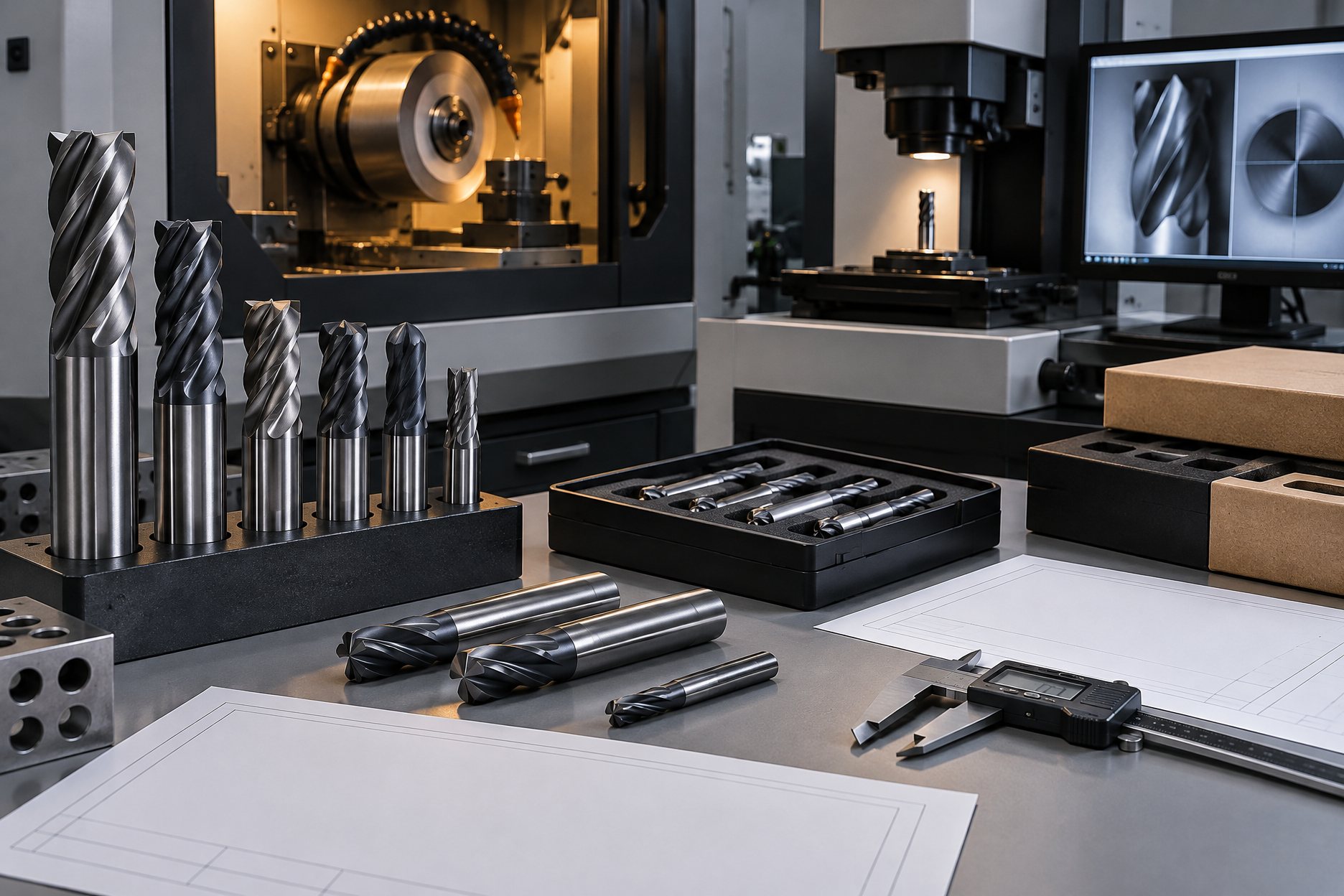
Why the holder belongs in the tool conversation
An end mill is specified to rotate about its axis; a holder decides how close to that promise reality gets. Any eccentricity between the spindle's rotation and the tool's cutting edges - runout, in the trade's shorthand - is divided unevenly across the flutes: one edge takes a deeper bite than designed while another rubs. The deeper edge wears on a schedule set by its worst moment, and the rubbing edge polish-hardens surfaces exactly as described on the stainless page. Rigidity matters alongside straightness: a tool gripped loosely or overhung far converts feed into deflection, and deflection becomes chatter, poor finish and early edge failure. The note on runout and tool life covers the mechanism; the point for a buyer is that holder quality is not an accessory decision but part of how the geometry you paid for gets delivered to the cut.
ER collet chucks: the flexible workhorse
ER collet chucks grip the tool shank in a collapsing slotted sleeve, tightened by a nut. Their virtue is range: one chuck body serves a span of shank sizes by swapping collets, which makes them the default choice on machines that change tools often and cut varied work. Their trade-offs are equally practical. Grip strength and rigidity sit below dedicated holders, so very heavy cuts favor stiffer options; and collet condition matters more than buyers expect - a worn or dirty collet quietly adds runout that no amount of tool quality removes. The habit that keeps ER systems honest is boring but real: clean the collet and the shank, seat the tool fully, tighten to spec, and replace collets on a schedule rather than on failure. For most general milling, a healthy ER setup delivers the geometry the spec sheet promised.
End mill holders: the Weldon-style flat
The holder most people mean by the phrase is a plain bored holder that grips the shank in a precise bore and locks it with a set screw pressing on a flat ground on the shank - the Weldon-style flat. The design's virtue is positive drive: the screw, seated in the flat, stops the tool from spinning or pulling out under heavy cuts, which is why these holders have long been the answer for roughing work and heavy milling. The trade-off is balance and concentricity: the set screw introduces a small asymmetry, so runout tends to sit slightly above what a precision collet or a shrink fit achieves, and the tool cannot axial-adjust for length the way a collet setup can. Shanks carry the flat only on tools made for this system - one more reason the shank line on the sizes page is a real specification rather than a footnote. Match the holder system to the tool as deliberately as the tool to the material.
Shrink-fit and hydraulic chucks: context for demanding work
Two further families complete the map. Shrink-fit chucks heat the holder bore so the shank seats when it cools - an extremely rigid, concentric grip favored in demanding production, at the cost of induction heating equipment and slower tool changes. Hydraulic chucks grip through a thin fluid-filled sleeve pressurized by a screw, delivering strong concentricity and damping with quick changes, at a higher price per chuck. Both earn their keep in high-precision or high-volume contexts; both are context for this site rather than subject matter, because the desk's work is the cutting tools themselves. The practical takeaway for a tool buyer is simpler: know which system your customers run, because it constrains which shanks and flats you should stock, and it sets expectations for how much of the geometry's potential survives the trip into the spindle.
| Holder type | How it grips | Where it fits |
|---|---|---|
| ER collet chuck | Collapsible collet over the shank | General milling; flexible across diameters |
| End mill holder (Weldon-style) | Precision bore plus set screw on a shank flat | Heavy cuts and roughing; positive drive |
| Shrink-fit chuck | Thermal shrink over the shank | Demanding production; rigidity and concentricity first |
| Hydraulic chuck | Pressurized fluid sleeve | Precision and damping with quick changes |
Runout: qualitative, checked, confirmed
Runout deserves a number in every shop's habit and a qualitative answer in every catalog's copy. Measured, it is total indicator reading at the cutting edge with the tool assembled in its holder - and it is checked on inspection as part of the desk's program QC, with acceptance levels agreed per program and confirmed on the spec sheet rather than advertised in general terms. Described, the logic is the same at any magnitude: runout loads flutes unevenly, uneven loading shortens the weakest edge's life and degrades finish, and the loss compounds over the tool's whole working life. Shops that measure runout at assembly catch worn collets, dirty tapers and damaged shanks before they write the damage into a batch of parts; the inspection habit is described alongside the factory-side checks in the note on end mill inspection and on the quality control page.
Where the desk stands on holders
Holders are an adjacent category: the desk describes them because tool programs are incomplete without the context, but they are not a core Millcrown line - the core is the cutting tools, their geometry and their paperwork. When a program genuinely needs holders alongside the tools, the honest path is to say so and to raise the question with the partner network per program, confirming availability and specification in writing rather than implying a standing range. What the desk does keep in its own lane is the interface knowledge: which shank sizes and flats pair with which systems, how holder condition feeds the runout conversation, and why the speeds a buyer tunes - the arithmetic sits on the speeds and feeds page - only mean what the holder lets the tool deliver. Bring the holder systems your customers run to the quote form; it shapes the shank lines on the sheet. Reference quantities and lead times per program are collected on the MOQ and lead time page.