
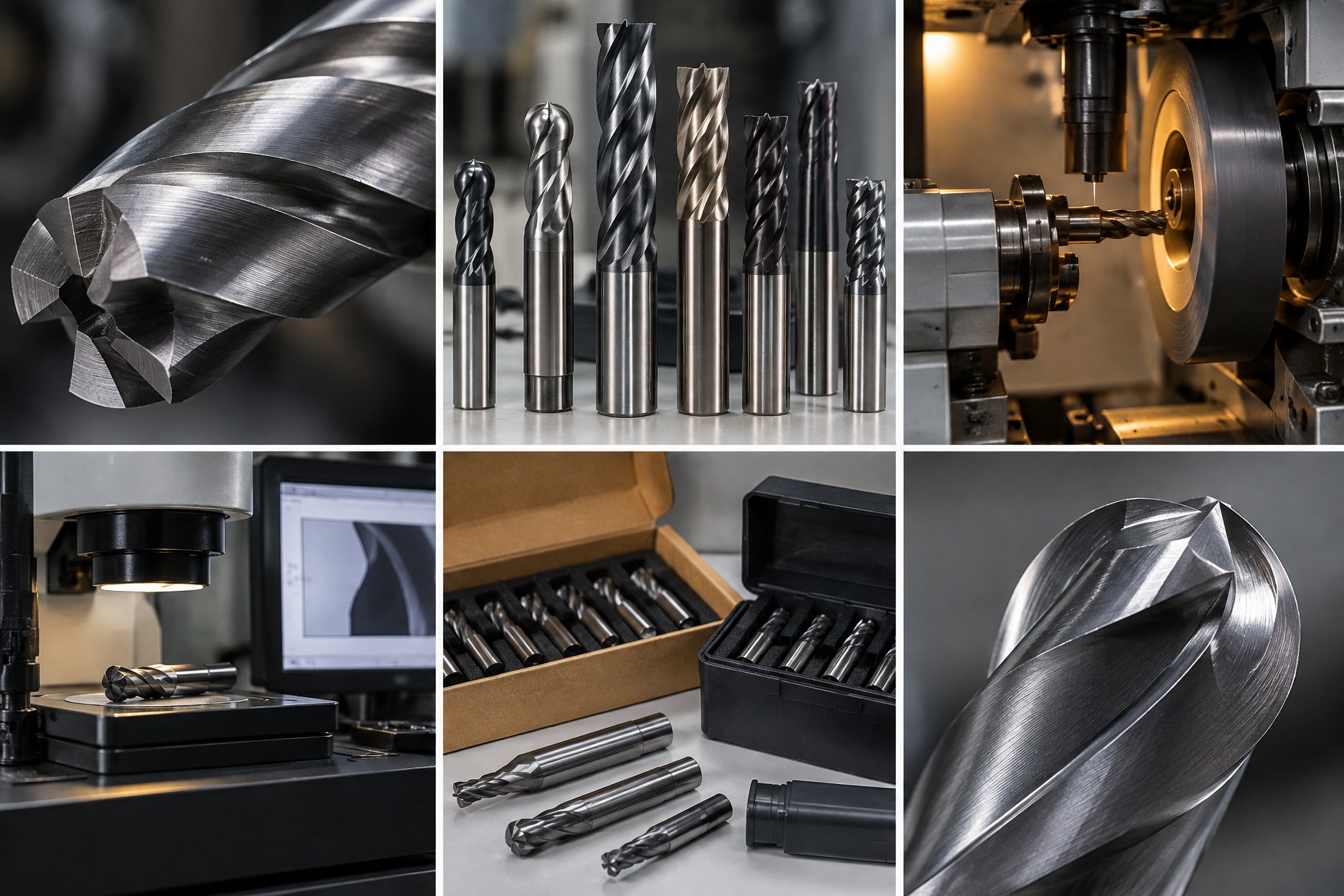
Why carbide became the default
Solid tungsten carbide is much stiffer than high-speed steel, which shows up exactly where milling needs it: less deflection at a given reach, better finish at a given feed, and the heat tolerance that modern coatings and higher cutting speeds ask for. That is why carbide end mills have become the default for CNC work on metals, while HSS keeps a real place where toughness and price lead - covered on the HSS page.
"Carbide" is not one material, though. The substrate is tungsten carbide grains in a cobalt binder, and the grain size is the specification that matters most. Fine and ultra-fine grains give a sharper, stronger cutting edge that holds its geometry longer; coarser grades trade edge quality for economy. What suits a program depends on the workpiece and the operation, and it is one of the first lines on the spec sheet we write with buyers. Grain specifics are confirmed by the factory in writing per program rather than advertised in general terms.
Geometries in carbide
Every geometry family the desk coordinates is available in solid carbide. The table below is the map; each family has its own spec page.
| Geometry | Standard description | Typical work |
|---|---|---|
| Square end mill | Sharp 90-degree corner | Slots, profiles, general milling |
| Ball nose end mill | Hemispherical end | 3D contouring, molds, finishing curves |
| Bull nose / corner radius | Radius at the corner | Longer-life milling on harder alloys |
| Roughing end mill | Serrated periphery | High metal removal before finishing |
| Tapered end mill | Conical body | Draft angles, mold cavities, engraving |
| Chamfer mill | Chamfer cutting geometry | 45-degree breaks and deburring |
| Corner rounding | Full-radius form profile | Fillets and edge radiusing |
| Thread mill | Thread profile on the periphery | Threading by helical interpolation |
Coatings, and the polished exception
Most carbide end mills run a PVD coating from the TiAlN family for steels and dry machining, or TiN for general purpose work. Aluminum is the important exception: an uncoated tool with polished flutes resists built-up edge better than most coatings, which is why the aluminum selection usually lands there. Abrasive non-ferrous and composite work may call for the diamond coating family. Coating families are described generically and confirmed per program - the desk does not sell coating brands, and coating choice is part of the spec sheet, not an upgrade upsell.
What the spec sheet names
A carbide end mill program is quotable only when the sheet is complete. The lines that matter:
| Diameter (D) | Cutting diameter, inch or metric, per line item |
|---|---|
| Length of cut (LOC) | The axial cutting length; stub, regular and long variants exist |
| Overall length (OAL) | Shank end to cutting end |
| Shank (Shk) | Usually equal to diameter on metric tools; check inch lines |
| Flutes | 2, 3, 4 or more - see the flute count guide |
| Helix | General-purpose, high-helix or low-helix per the material |
| Corner | Sharp, radius, or chamfered; radius value confirmed per spec |
| Substrate / coating | Fine-grain carbide; TiAlN family, TiN, uncoated polished, diamond family |
| Marking | Neutral or your logo, laser marked on the shank |
If you already have a sheet in this shape, send it with the quote form - it quotes faster than a conversation.
Standard or ground to your drawing
Standard carbide end mills follow reference geometry in the common diameter range and ship boxed, commonly ten pieces per box. That route suits distributors and resellers filling a catalog. When the range needs your geometry - a special corner radius, a taper angle, a flute count the catalog does not carry - the OEM route grinds to your drawing with your logo on the shank, from quantities that start around 50 to 100 pieces per specification for standard geometries. Custom grinding samples take about 15 to 25 days after the drawing is agreed, and bulk about 30 to 45 days after approval. Read the OEM route in detail, or the marking and boxing specifics under private label.
How carbide programs are priced and packed
Two practical notes buyers ask about early. Packing: solid carbide end mills are fragile at the edge before they are fragile anywhere else, so the standard is a closed box with the tools separated - commonly ten pieces per box, one geometry per box - inside a carton that keeps them dry in transit. Marking: the shank carries a laser line with the geometry code, and under the OEM route, your logo and part number instead. Both lines are on the program sheet, because repacking or remarking after the fact is exactly the kind of avoidable cost the desk exists to prevent.
Pricing is quoted per program from the spec sheet - geometry, substrate, coating, quantity and packing all move it - and never as a catalog price list. What the desk can publish is the reference rhythm: samples for ground-to-order tools in about 15-25 days, bulk in about 30-45 days after approval, coated programs a few days over uncoated. Quantities and prices arrive in writing, per program. The MOQ and lead time page collects those reference points in one table.
What the desk checks before bulk
Carbide programs are checked against the approved sample, not against a catalog photo: optical measurement of diameter and flute geometry, runout at the cutting edge, coating appearance, marking and packing. A certificate of conformance and material certificates travel with the shipment per program. The full checklist lives on the quality control page; the desk's role is to make sure the sheet you approved is the sheet that ships.