
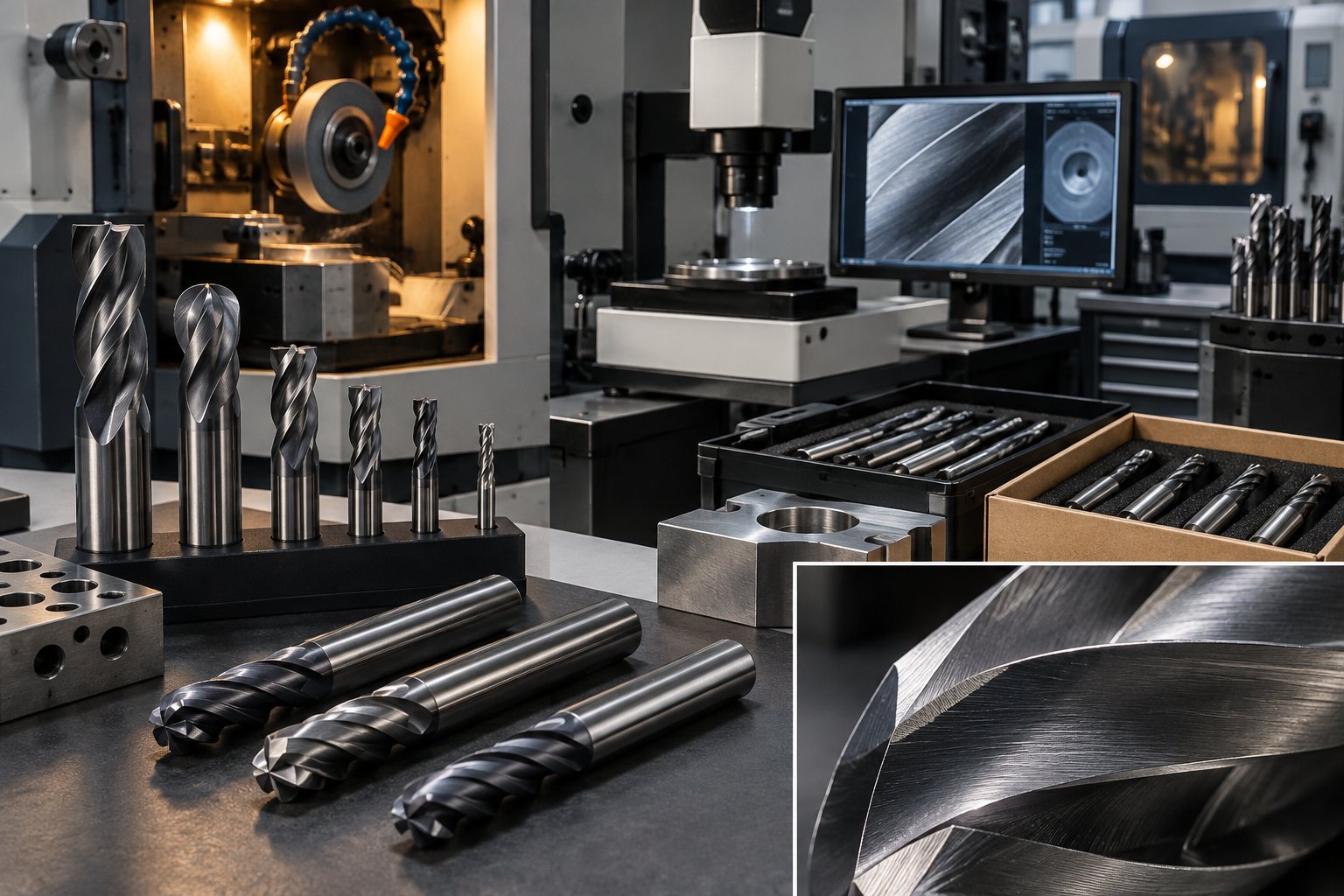
What a flute is, and what it costs
Each flute on an end mill is two things at once: a cutting edge on its entry face - the edge that meets the material first - and a gullet behind it that carries the chip away. Those two jobs compete for the same real estate. Deep, wide gullets give chips an easy exit but leave less metal in the middle of the tool, so the core is thinner and the tool flexes more. Shallow gullets leave a fat, stiff core but cramp the chip. Flute count is the dial that moves a tool along that trade-off, which is why the question "how many flutes?" is really the question "how much chip room does this material need, and how much stiffness can I trade for edge count?". Answer those per material and the numbers follow; the note on flutes explained covers the anatomy in more detail.
Two flutes: chip room first
A two-flute end mill dedicates half its circumference to each gullet, which is why it clears chips better than any common alternative. That makes it the default for aluminum and other soft, sticky materials, for deep slots where chips have a long climb to escape, and for plunging work where the gullet does double duty. The cost is edge count: two edges per revolution means each edge takes a heavier bite at a given feed, and the finish potential is the lowest of the common counts. None of that is a defect - in deep aluminum pocketing, the tool that cannot evacuate chips is the tool that welds them to its flutes, and everything else is commentary. The head-to-head with the four-flute answer is in the note on two flute versus four flute.
Three flutes: the aluminum compromise
Three flutes occupy the middle ground so useful in aluminum work that they have become a signature of the material. Compared with two flutes, they add an edge per revolution - better finish potential and smoother cutting - while keeping gullets generous enough for aluminum's large chips. Compared with four, they keep the chip room aluminum demands. That balance explains why so many aluminum programs stock both a two-flute line for slots and deep pockets and a three-flute line for profile and finishing work; the dedicated note on the three-flute end mill in aluminum walks through where each earns its place. Outside aluminum, three flutes appear on some stainless and general-purpose lines where the same middle ground suits the chip - the material pages carry the specifics.
Four flutes: steels and finishing
Steel chips are smaller and more brittle than aluminum chips, so they need less gullet - and edge count starts to pay. Four flutes is the workhorse count for steel: four edges per revolution, a better finish potential, and a stiffer core because the shallower gullets leave more carbide in the middle. In finishing work the same logic holds even in softer materials, because light chip loads generate small chips and the finish comes from edge count and sharpness rather than from chip room. Five and six flutes extend the same direction: in harder materials they raise feed potential - more edges sharing the work lets the table push harder at the same per-edge load - which is why they show up on hardened-steel and high-productivity finishing lines rather than on aluminum shelves. Where each count earns its keep on specific alloys is set out on the steel page and its siblings.
| Flutes | Strong suit | Watch out | Common homes |
|---|---|---|---|
| 2 | Maximum chip evacuation; plunging | Fewer edges; heavier bite per edge | Aluminum, deep slots, soft materials |
| 3 | Balanced room and edge count | Not the maximum of either | Aluminum profiling and finishing; some general work |
| 4 | Edge count with a stiff core | Cramped for big chips | Steels, stainless, finishing passes |
| 5-6+ | Feed potential in harder materials | Small gullets demand small chips | Hardened steel, high-productivity finishing |
The core thickness trade-off, stated plainly
Beneath every flute-count decision sits the core. As flute count rises at a given diameter, each gullet narrows and the solid core between them thickens - a four-flute tool is measurably stiffer than a two-flute tool of the same diameter, which matters in long tools and hard materials. The price is chip capacity: the same shallowing that stiffens the tool shrinks the passage each chip must climb. There is no configuration that wins both, so the honest spec sheet never claims it; instead it names the count that matches the material's chip and the operation's stiffness demand. Buyers writing catalogs should let the trade-off structure their range rather than fighting it: chip-room lines for soft and deep work, edge-count lines for steels and finishing, and the two families labeled by what they are for.
Flute count connects to everything else
The count you choose moves the rest of the program. Speeds and feeds: edge count enters the feed formula directly, since feed equals chip load times flutes times RPM - the arithmetic is on the speeds and feeds reference. Geometry family: roughing tools trade gullet polish for serrations, finishing tools push edge count, and the material pages - aluminum, steel, stainless, titanium - show how the same count shifts meaning by alloy. Sizes: very small diameters physically hold fewer flutes, which is one more reason to spec diameter and count together rather than sequentially. When the desk writes a program, flute count is settled after the material list and before the coating line, and it is confirmed per spec sheet - the factories confirm what each line carries, in writing, before sampling. Bring your material list to the quote form and the reply will propose counts per family, with the reasoning on the sheet where you can argue with it.