
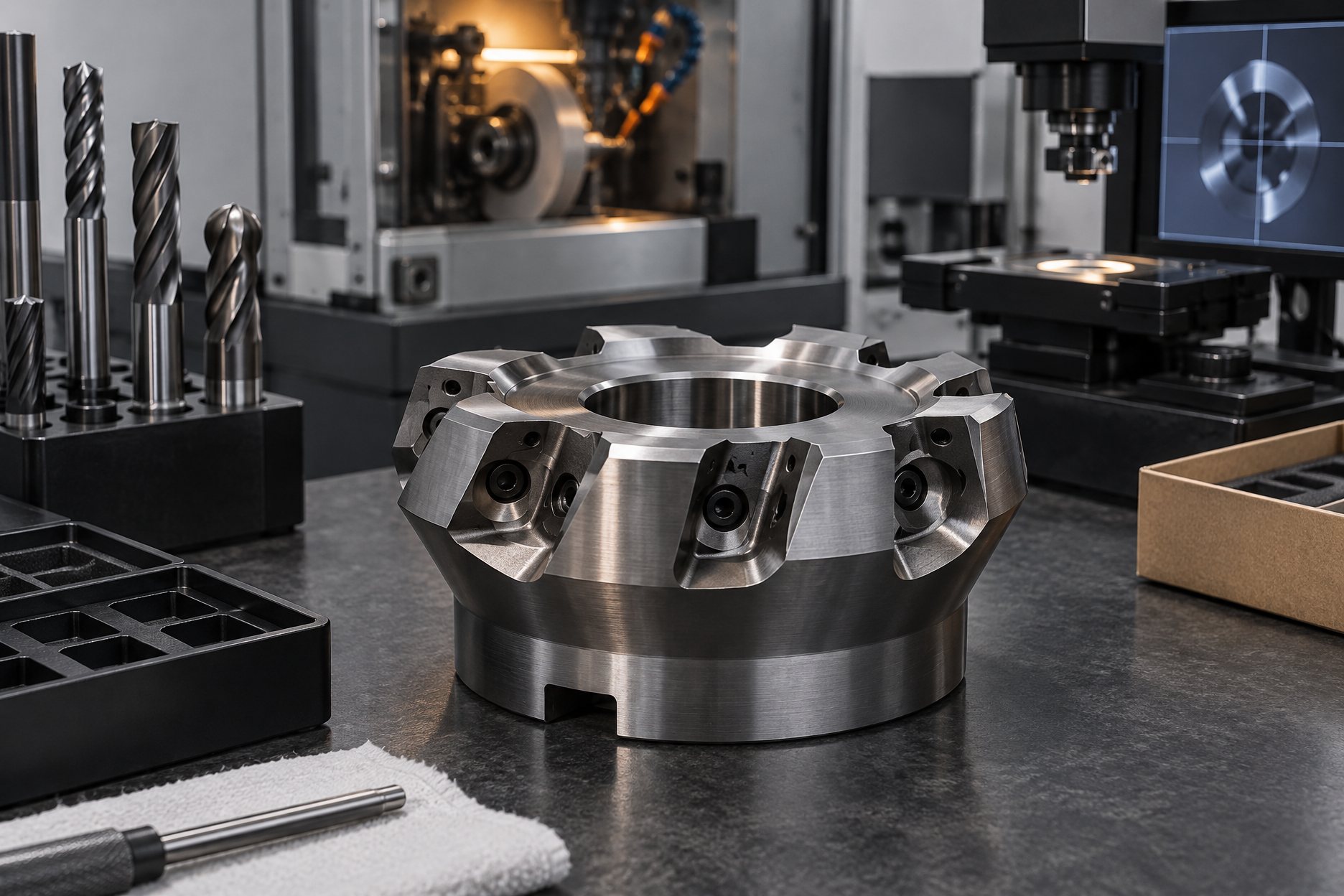
Flat surfaces, cut with the face
A face mill machines flat surfaces with the face of the cutter: the tool's axis is perpendicular to the surface, the insert edges or peripheral teeth do the cutting across the full width, and the result is a flat plane produced in one wide pass. That is the contrast with an end mill, which is a narrower tool that builds a surface by stepping across it. On a bracket face, a cover flange or a machined table, a face mill sweeps the whole feature in passes counted in single digits where an end mill would count in dozens. Diameters run large - from small shell forms up to bodies several hundred millimeters across - with the exact size range confirmed per spec.
Why width changes the economics
When the tool's width covers the feature, the arithmetic of facing changes. Passes collapse, edge engagement per pass stays shallow and consistent, and heat lands in the chips rather than the part - which is why large facing work on weldments, castings and plates has belonged to face mills for as long as there have been milling machines. The same arithmetic argues against using a face mill everywhere: on a small part, most of the body is air, and an end mill held in the same tool changer finishes the feature without a dedicated pocket. Matching cutter width to feature width is the first decision in facing, and it is made from the drawing, not from habit.
Indexable bodies, replaceable inserts
The dominant form is the indexable body: a cutter body in tool steel carrying replaceable carbide inserts seated in pockets around the periphery. The body holds the geometry and the balance; the inserts carry the cutting edges and are reindexed or replaced as they wear. The alternative is the solid face mill, ground or fitted with edges as one piece. The trade-off is the classic one, covered in indexable vs solid carbide milling: indexable bodies win on economy of edges and quick recovery on the shop floor; solid forms earn their place where the finest surface is the point. For most production facing, indexable is the default.
Face mill or end mill for facing?
The honest answer is by the job, and the comparison note goes deep; the short version fits a table.
| Situation | Better fit | Why |
|---|---|---|
| Large flat area, many parts | Face mill | Wide passes; edges reindexed, not reground |
| Small part, few faces | End mill | One setup, one tool, no insert stock |
| Machining center with tool pockets to spare | End mill | Avoids a dedicated pocket and insert inventory |
| Dedicated facing station or transfer line | Face mill | Width, edge count and repeatability pay daily |
Insert supply is part of the program
A face mill program is a body-and-insert program, and the desk treats it that way. The body is quoted with its insert family - described generically, by shape and coating family rather than by brand - and the insert supply plan is part of the written program: what ships with the body, what reorders look like, and how reindexing stock is packed. A body without a predictable insert supply is half a tool; buyers who have been stranded by a discontinued insert know exactly what that sentence costs. Insert shape, count per body and coating family are confirmed per spec sheet, and the pairing of body to insert family is written before the order, not discovered after it.
Geometry lines that matter
Beyond diameter, three lines shape the cut. Lead angle: the common families work at or near 90 degrees for square-shoulder work and nearer 45 degrees where a softer entry and thinner chips help - qualitative family descriptions, with the exact angle confirmed per spec. Insert count: more seated edges spread the load and raise feed potential, at the cost of spindle power and per-edge economy. Mounting: bodies are specified by their bore and drive for arbor mounting, or by integral shank on smaller forms, and the fit must match your holder stock - a mismatch there is a logistics problem, not a cutting problem.
What the spec sheet names
| Body diameter | The width of the cut swept per pass |
|---|---|
| Insert family | Generic shape and coating family; brand names not used |
| Insert count | Edges seated in the body |
| Lead angle | Confirmed per spec, per family |
| Mounting | Bore and drive, or integral shank |
| Marking | Neutral or your logo on the body |
Checking a face mill before it ships
Indexable bodies are inspected differently from solid tools: seat geometry and seating surface, body runout with inserts seated, and balance on larger diameters. Insert pockets that sit slightly off show up as edge height differences that no feed rate hides. The inspection plan for a face mill program covers the body against the approved sample and includes the packing check - inserts boxed separately, body protected, both marked per the sheet. The general checklist lives on the quality control page, and the plan for a specific program is confirmed in writing with the quote.
Standard bodies or your program
Standard bodies in the common diameter range are quoted from the catalog with their insert families. A buyer building a house range - own marking on the bodies, own packaging, insert program matched to their market - runs the OEM route, where quantities start around 50 to 100 pieces per specification and non-standard diameters are quoted per program from a drawing. Reference rhythm: samples about 15 to 25 days for ground-to-order items, bulk about 30 to 45 days after approval, confirmed in writing on the MOQ and lead time page. Send the diameters, insert family and market with the quote form and the first reply will name the route and the open lines.