
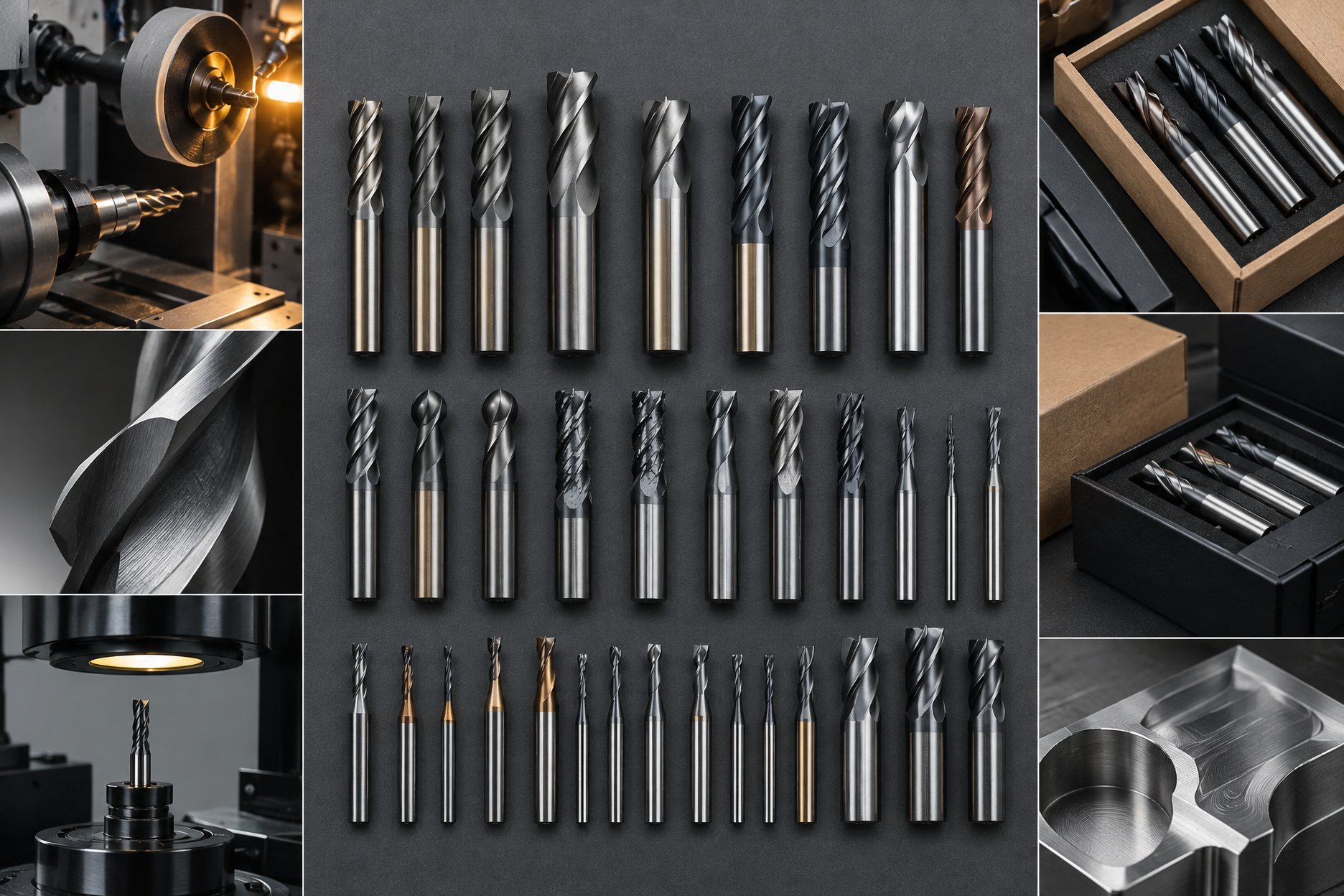
Two series, one physical tool
End mills are sold in two diameter series - inch and metric - and the same physical concept sits behind both: a rotary cutter defined by the width of slot it cuts. The inch series descends from fractional conventions, with sizes named in fractions of an inch and their decimal cousins; the metric series runs in clean millimeter steps. Because the United States market and much of the world's machine stock still straddle the two, a serious program specs both series explicitly and refuses to convert in its head. A quarter-inch tool and a six-millimeter tool differ by about four hundredths of a millimeter - close enough to seem interchangeable on a spreadsheet, different enough to matter in a bore, a keyway or a holder sized for the other series. The history and the practical split are set out in the note on end mill sizes and diameters; this page keeps to the naming and the decisions.
The four numbers on the label
Every end mill, in either series, is specified by four size lines, and the abbreviations appear on boxes and spec sheets in a near-universal shorthand.
| Line | Shorthand | What it tells you |
|---|---|---|
| Diameter | D | The cutting diameter - the width of the slot the tool cuts |
| Length of cut | LOC | How deep the flutes reach axially - the depth a full-flute pass can work |
| Overall length | OAL | The whole tool, shank end to cutting end |
| Shank | Shk | The plain cylinder the holder grips |
Two of these cause the most sourcing friction. Length of cut is the reach line: choosing a LOC shorter than the feature wastes nothing, choosing one that barely reaches invites rubbing near the flutes' root where the core is thickest. Overall length matters to the machine envelope and to reach around fixtures. Both have their own note at length of cut, OAL and reach. The diameter line itself is the one that interacts with everything else on this site - flutes, speeds, holders - because the same diameter in different flute counts is a different animal, as the flute count guide shows.
Stub, regular and long
For a given diameter, the trade names three length variants. A stub end mill is short: minimal LOC and minimal OAL, built for rigidity, and the correct answer whenever reach allows - deflection grows with overhang, and stub tools are the most economical stiffness available. A regular tool carries the conventional proportions most catalogs imply when no variant is named. A long end mill - and beyond it the long-flute and extended-reach families - buys axial reach at the cost of rigidity, and should be specified deliberately: reach you need, not reach you might want. Writing "6 mm, 4 flutes" on a purchase order without naming the variant is how a rigid stub expectation arrives as a floppy long tool; both are valid six-millimeter four-flute end mills. The comparison, with the trade-offs spelled out, is the note on stub, regular and long end mills.
What the box label carries
Sizes travel on the label as well as on the sheet: the standard box lists diameter, flute count, LOC, OAL and shank in the shorthand this page introduced, one geometry per box, so a warehouse picker never guesses between a stub and a long variant of the same diameter. The desk checks label legibility and series correctness during inspection, because a right tool in a mislabeled box fails the customer exactly as hard as a wrong tool. OEM programs replace the neutral label with the buyer's own codes, per the marking plan agreed in the program sheet.
Inch and metric side by side
| Aspect | Inch series | Metric series |
|---|---|---|
| Diameter naming | Fractions and decimals of an inch | Clean millimeter steps |
| Shank convention | May differ from the cutting diameter - check the line | Usually equal to the cutting diameter |
| Common failure | Shank assumed equal to diameter | Converted from inch drawings instead of specced |
| Holder fit | Holder must match the actual shank | Holder matches the nominal shank |
| Spec sheet habit | Name the series on every line | Name the series on every line |
Shank equals diameter - on metric tools
The metric convention is friendly and worth knowing cold: on most metric solid end mills, the shank diameter equals the cutting diameter, so a six-millimeter cutter grips in a six-millimeter collet or bore. The inch series never promised that - fractional-diameter tools may carry a shank of a different standard size - which is why the shank line exists on the spec sheet at all. The holder side of the match is its own subject, covered on the holders page; the practical point for sizing is that the shank is a real line to confirm, not a footnoted assumption, and that mixed shipments with one series mislabeled remain a classic sourcing failure a careful sheet prevents.
How sizes are confirmed per program
The desk does not publish a fixed size list, because the useful answer depends on the program: which geometries, which substrates, which diameters your customers actually buy. What happens instead is concrete. You send the diameter range and the series split; the partner factories confirm availability per line in writing, including the LOC and OAL variants and the shank for each; the spec sheet names every size line item by item, and inspection measures against those numbers before boxing. Standard catalog items cover the common sizes in boxed quantities, with reference lead times on the MOQ and lead time page; OEM programs follow your drawing, from quantities around 50-100 pieces per specification for standard geometries. A diameter the catalog does not carry becomes a grinding question rather than a refusal - the custom grinding route exists precisely for the sizes between the standard steps. Send the range through the quote form and the reply will separate the lines that are ordinary from the lines that need a drawing.