
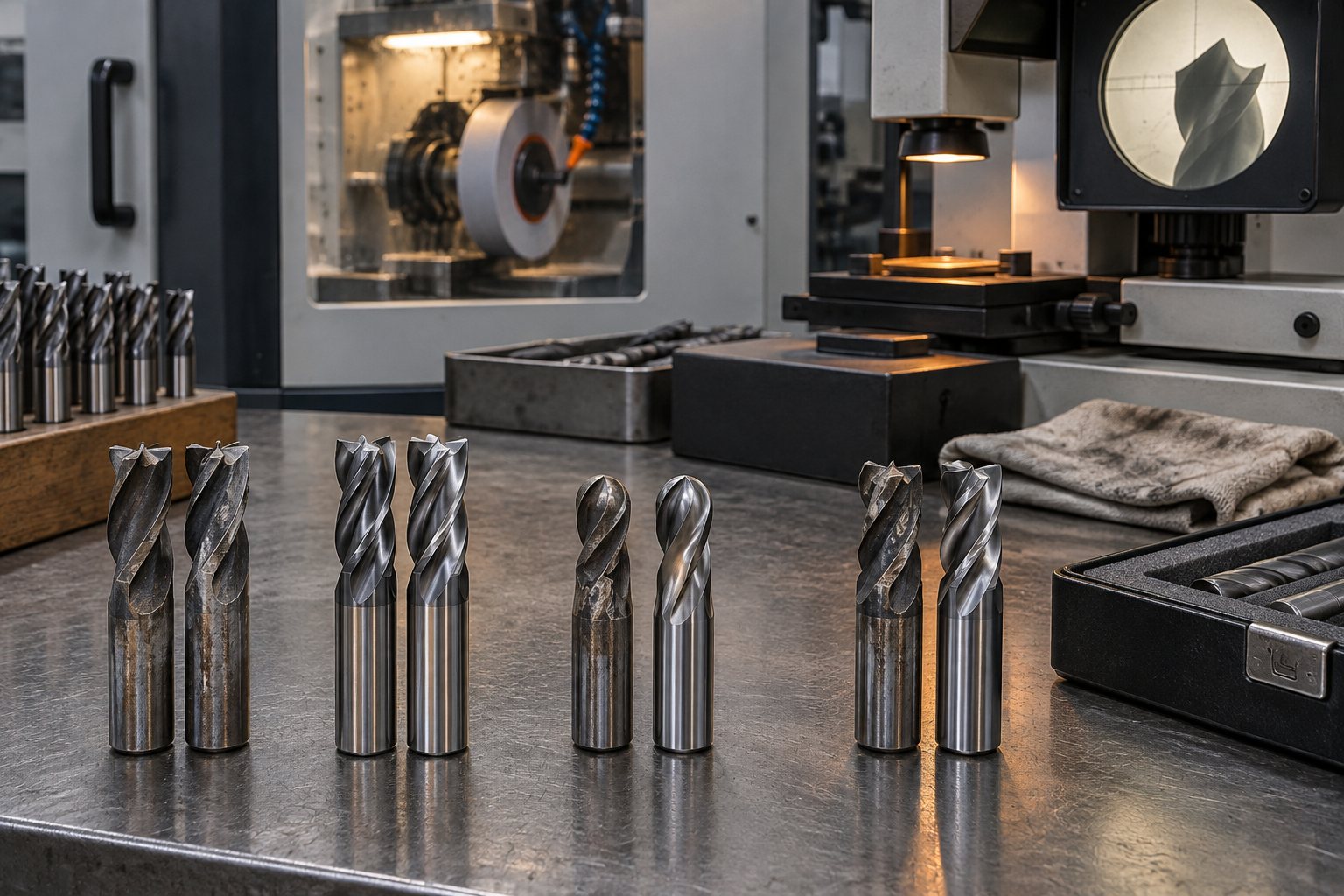
Two meanings, one page
Buyers search for custom end mill grinding with one of two problems in hand. The first: a part on the machine needs a tool nobody stocks - a special taper, an unusual corner radius, a length the catalog stops short of - and the fix is a new tool ground to drawing. The second: a program's tools are worn, and the economics argue for restoring them rather than scrapping them - a regrind, usually with a fresh coating. The two jobs share a factory floor and a vocabulary, which is why they get one page here, but they start differently: new tools start from your drawing, regrind starts from the tool's original geometry record. Both are OEM route work at partner factories, and both are quoted per program in writing.
New tools ground to your drawing
A new custom tool is a translation exercise. Your side holds the cutting problem; the factory holds grinding programs and fixture setups. The drawing is the translation layer, and its quality decides everything downstream - sample speed, batch consistency, and whether reorder number three matches sample number one. Grinding runs on five-axis CNC at partner factories in the Changzhou cluster, which means your geometry becomes a machine program: precise, repeatable, and changeable only on paper first. That is the discipline that makes custom tools quotable at all, and it is why the desk insists the drawing and spec sheet are settled before the first blank is cut.
What makes a drawing quotable
| Line | What to state | Why it matters |
|---|---|---|
| Geometry | Diameter, LOC, OAL, shank, flute count, helix, corner style | Defines the tool; every later step checks against it |
| Tolerances | Diameter and runout acceptance per program | Sets the inspection plan and the achievable process |
| Substrate | Fine-grain carbide or HSS family, named | Decides edge behavior and coating compatibility |
| Coating | TiAlN family, TiN, uncoated polished, diamond family | Adds days; changes the edge prep stage |
| Quantity | Pieces per specification for the first batch | Moves the quote; sets the sampling plan |
A drawing missing one of these lines is not unbuildable - it is unquotable, because the factory would have to assume the missing values and you would be buying their assumptions. Filling the lines is fast: the desk converts sketches, sample descriptions or a competitor spec sheet structure into the sheet format, you approve it, and the factory quotes against it. The line-by-line template is in the spec sheet template, and the full walkthrough from drawing to sample in the custom grinding guide.
From drawing to sample
The rhythm is the OEM route's standard one: drawing agreed, sample ground, sample approved in your hands or on your machine, then bulk. Ground-to-order samples typically take about 15 to 25 days after the drawing is agreed, bulk about 30 to 45 days after approval, coating adding a few days - typical reference ranges, each confirmed in writing for your program. Use the sample round seriously: it is the moment to check the geometry on your machine, in your material, and to send back one revision rather than five. A drawing that survives sample approval unchanged is the single best predictor of a calm bulk run and a matching reorder.
Regrind and recoat for worn tools
The second meaning of custom grinding is the afterlife. Worn tools are re-ground on their original geometry - the grinding program for your tool already exists, which is what makes restoration exact rather than approximate - and then re-coated so the tool returns with a fresh edge and a fresh surface. Regrind is quoted per batch and confirmed per program: quantity in, condition assessed, geometry restored, coating renewed, tools back in boxes. It suits programs that control their tooling usage and can collect worn tools per batch - distributors running their own service loops, job shops with expensive special profiles, brands supporting tools already in their customers' machines.
What regrind is not is a rescue for every worn tool. Tools worn past their geometry, chipped below the coating, or originally ground to undocumented geometry are poor candidates - restoration needs a geometry to restore to. That is the quiet argument for keeping the spec sheet of every custom tool on file: the sheet is what makes the tool regroundable for the rest of its life. The sampling discipline behind that record is in the sampling note.
Sharpening context: the shop bench versus the regrind batch
A third word orbits this subject: sharpening. In-shop sharpening - the bench-top end mill sharpener territory - restores a usable edge quickly and cheaply, and for many job shops it is the right first response to a dull tool. A professional regrind is a different product: original geometry restored on the machine program that cut it, tolerances held, coating renewed. The first keeps a tool cutting; the second returns a tool to specification. Which suits your program depends on who uses the tools and what their work tolerates - the comparison is laid out in the sharpener and regrinding note.
What the desk will not do
Two boundaries keep custom work clean. First, no copying of other companies' branded goods: custom grinding works from geometry values and drawings, not from someone else's marked tools. If you can read the geometry off a sample you own - diameter, flutes, helix, corner - the desk will build the sheet from those values as your geometry. Second, no performance fiction: a drawing and a coating describe a tool, not a result in your material. Speeds and feeds stay starting-point references, and no tool-life promise is attached to a quotation. What you get instead is the honest version: geometry to the sheet, checked per the inspection plan, with acceptance lines you set.
Send the drawing, or the problem
If you have a drawing, send it with quantities per specification through the quote form. If what you have is a worn batch, say so - regrind quotes per batch. If what you have is a cutting problem and no drawing yet, that is a normal starting point too: describe the part and the machine, and the first reply will name the geometry, the open lines and a sampling plan, in writing, with the rhythm references from the MOQ and lead time page.