
What the desk does
A milling cutter is a precise object sold in a precise language. Two 6 mm four-flute end mills can differ in substrate grain, helix angle, corner prep and coating, and those differences decide how the tool cuts in your material - and whether your customer reorders. The paperwork side matters just as much: a spec sheet that names every geometry line, samples that prove the geometry before bulk, certificates that travel with the shipment. None of this is complicated, but all of it has to be written down before grinding starts.
That is the desk's job. We take your brief, turn it into a spec sheet a factory can quote against, route it to a partner factory that already grinds that geometry family, and manage samples, inspection and packing. For standard items we quote from the catalog; for OEM programs we quote from your drawing. When something changes, you hear it from us in writing.
Where the tools are ground
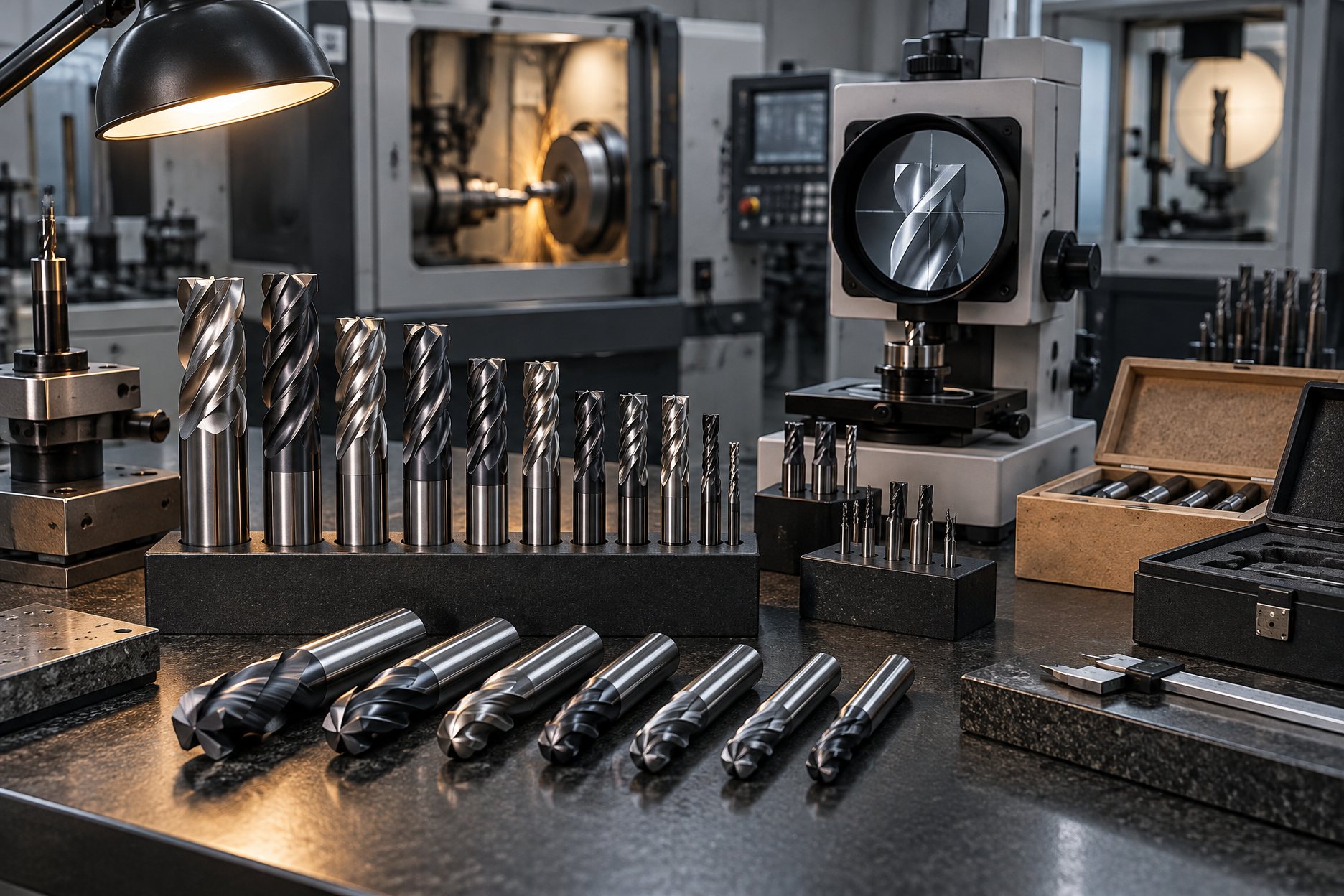
Grinding takes place at partner factories in the Changzhou cutting-tool cluster in Jiangsu. Chinese machine-tool industry reporting describes Changzhou's Xixiashu district as a town of tools, with several hundred cutting-tool enterprises and more than ten thousand people employed in the industry there. The cluster covers the full chain a milling cutter program needs: carbide rod blank preparation, five-axis CNC grinding of flutes and faces, edge preparation, PVD coating lines, laser marking, and inspection with optical profile measurement. Being dense matters: a coating line, a grinding shop and a marker are minutes apart, which is why a custom program can move from drawing to sample in weeks rather than months.
Partner factories range from shops that grind standard catalog geometry to ones that live on special profiles - tapers, custom corner radii, thread mill profiles. Matching the program to the factory that already runs that geometry is most of what a sourcing desk does. Read more in the sourcing network.
Two routes, one desk
The desk runs two routes because buyers arrive with two different needs. The standard route is for proven geometry: square, ball nose, bull nose, roughing, tapered and chamfer end mills in the common diameter range, ground to reference geometry, coated or polished, boxed - commonly ten pieces to a box - and ready to ship. The OEM route is for your own program: your geometry from a drawing, your logo laser-marked on the shank, your boxes. Standard geometry with your branding starts from moderate quantities per specification; non-standard profiles are quoted per tool family with a drawing. Typical reference points: custom grinding samples about 15 to 25 days, bulk about 30 to 45 days after approval, coating adding a few days. Every figure is confirmed in writing for your program; see MOQ and lead time.
| Question | Standard route | OEM route |
|---|---|---|
| Starting quantity | Boxed quantities; small lots fine | From about 50-100 pcs per spec for standard geometry with your mark |
| Geometry | Reference geometry from the catalog | Your drawing, ground to spec |
| Branding | Neutral boxes and labels | Your logo on the shank, your boxes and labels |
| Time to ship | Days for stock items | Samples about 15-25 days; bulk about 30-45 days |
What we claim, and what we do not
| Topic | What we say | What we do not say |
|---|---|---|
| MOQ and lead time | Typical reference ranges, confirmed in writing for each program | Fixed numbers for every geometry and coating |
| Price | Quoted per program from the spec sheet | Prices published on the site |
| Performance | Geometry described to standard trade usage; speeds and feeds as starting points only | Tool-life promises or "outperforms" claims |
| Factories | Partner factories in the Changzhou cluster, profile on request | That the grinding, coating or inspection lines belong to us |
| Papers | Certificate of conformance and material certificates provided per program in writing | That Millcrown holds a certificate |
How we talk about performance
Cutting tools attract bold claims, and we keep out of that business. Geometry on this site is described the way the trade describes it: flute counts and what they trade off, helix angles and where they help, coatings by generic family. The speeds and feeds section is explicitly a starting-point reference with the standard formulas, because real numbers depend on your machine, your setup and your workpiece - not on a catalog sentence. If a supplier ever promises you a tool life figure before seeing your part, treat that as a reason to keep reading specs.
Who we work with
Six kinds of buyer run through the desk. Cutting-tool brands building a range under their own name. Distributors and industrial supply houses filling stock programs. CNC job shops with non-standard needs. Mold and die shops that live on ball nose and tapers. Online sellers of CNC tooling. And education and maker programs buying by class set. The first reply always starts from your channel and your customers, because that decides the route and the spec sheet.
How a program runs
- Brief. Geometry, substrate, coating, sizes, quantity per specification, marking and packing. The quote form asks for exactly these.
- Spec sheet. We write the sheet: every geometry line, the substrate and coating family, marking, packing. You approve it.
- Samples. Standard items ship from stock; ground-to-order samples take about 15-25 days after the drawing is agreed.
- Confirm. Quantities, prices, lead time, inspection plan and papers in writing before bulk.
- Bulk and check. Inspection against the approved sample, geometry and runout checks, boxes and cartons per the sheet. See quality control.
Start the conversation
If you have a drawing, a competitor's spec sheet structure or a list of tools you already sell, send it with the quote form. If you only have a market and an idea of the range, send that - the first reply will name a route, a sampling plan and the questions still open, so your next decision is clear.