
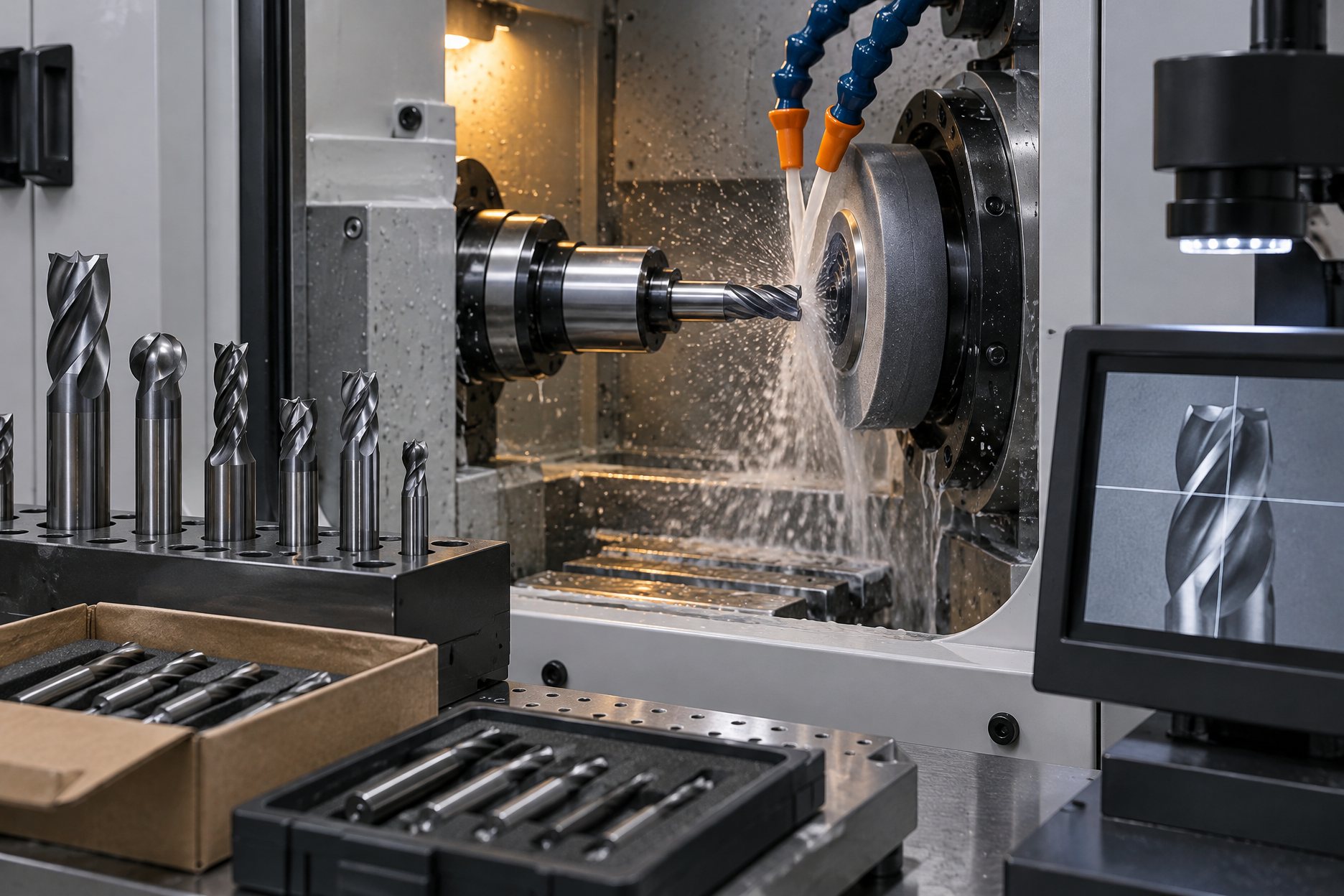
Why the cluster decides what your supplier can do
Most milling cutter problems trace back to distance. A grinding shop with no coating line nearby ships tools away for days before a batch can be marked; a marker three provinces over turns a packing week into a shipping fortnight; a shop that grinds only square geometry improvises when your range needs a taper or a thread profile. Buyers rarely see this plumbing, but they feel it in sample rounds that stretch across a month and in programs that stall halfway to bulk. Where the supply chain is dense, those frictions shrink. That is the argument for running a sourcing network inside a tool-making cluster instead of collecting suppliers one by one from a trade platform and hoping they cooperate with each other.
The Millcrown desk works from the Changzhou cutting-tool cluster in Jiangsu. This page explains what that means in practice: what the cluster is, what each link in its chain contributes, and how a program gets matched to a factory that already grinds that geometry family every week. Factory-specific figures - machine counts, monthly output, headcount per shop - are not published on this site; they are provided in the factory profile on request, once a program is under discussion.
A town of tools, in industry reporting
Chinese machine-tool industry reporting describes Changzhou's Xixiashu district as a town of tools: several hundred cutting-tool enterprises based there, and more than ten thousand people employed in the town's tool industry. We quote that qualitatively and with attribution, for two reasons. Published output figures age quickly, and a procurement decision should rest on what a factory can do for your program rather than on district statistics. What the reporting does support is the shape of the place - a district whose core industry is cutting tools, with the ecosystem such a concentration builds around itself: carbide rod sellers, grinding shops at every scale, coating lines, marker services, packaging printers and inspection resources within a short drive of one another.
Density changes behavior in small, practical ways. A coating batch can slot into a line's schedule the day grinding finishes. A marking proof can be checked in person before the first production run. When one shop's queue is full, the desk can route the same geometry family to another without changing provinces. None of this appears on an invoice, which is why it rarely makes it into a supplier pitch - but it decides how reliably your program ships on the rhythm written into the program sheet.
The chain, link by link
A solid carbide end mill moves through a short chain, and the cluster covers every link of it close together:
| Chain link | What happens there | What the desk watches |
|---|---|---|
| Carbide rod preparation | Rods sourced and cut into blanks | Substrate grade named in writing |
| Five-axis CNC grinding | Flutes, faces and clearances ground | Geometry against the spec sheet |
| Edge preparation | Cutting edges honed for strength | Edge prep matched to the coating plan |
| PVD coating | TiAlN, TiN and related nitride coatings at partner coating lines | Batch traceability through the run |
| Laser marking | Logo, geometry code, part number on the shank | Proof approved before the batch |
| Optical inspection | Geometry measured, runout checked at the cutting edge | Acceptance criteria set per program |
| Packing | Boxed - commonly ten pieces per box - and cartoned | Labels match the program sheet |
Two things about the chain matter to buyers. First, the steps are separable: grinding may sit at one factory while the coating batch runs at a nearby partner line, which is normal here and written into the program sheet rather than left implicit. Second, each step produces a checkpoint you can hold - a named substrate, a sample you approve, a marking proof you sign off, an inspection result you receive. The production process page walks the chain in order; quality control covers what is checked and against what.
Matching the program to the factory
Factories in the cluster are not interchangeable. Some grind standard catalog geometry at volume; some live on special profiles - tapers, custom corner radii, thread mill forms; some are organized around HSS lines rather than solid carbide. Matching a program to the factory that already runs that geometry family is most of what the desk does, and it starts from the geometry, not from a factory list. A square end mill line with your logo routes differently from a special taper ground to an approved sample; a mixed-geometry starter program may split across two factories by family, with a single packing point at the end.
The matching questions are concrete: which geometry families does the shop grind daily; does it hold its coating relationship in-house or nearby; has it run boxed, retail-grade packing under private label; can it carry the regrind conversation when the program matures. Answers go into the factory profile and into the program sheet, so your decision rests on written capabilities rather than a sales conversation. The desk's role is described in about Millcrown; the branding specifics sit under private label.
What we do not publish, and why
No factory names appear on the public site, and no factory numbers are invented to fill the gap. That is deliberate. The partner factories are independent businesses, and broadcasting their names invites enquiries that bypass the program discipline the desk exists to enforce - no spec sheet, no approved sample, no papers. For buyers with a program under discussion the opposite applies: a factory profile is provided on request, in writing, covering capabilities, geometry families, quality setup and packing, so you know exactly which shop stands behind your order before the first sample is cut.
How a program enters the network
- Brief. Geometry, sizes, substrate, coating, quantity per specification, marking and packing - the quote form asks for exactly these lines.
- Spec sheet. The desk writes the sheet a factory can quote against; you approve every line before anything is cut.
- Factory match. The program routes to a shop that runs the geometry family, with coating and marking partners named in the sheet.
- Samples. Standard items from stock; ground-to-order samples typically about 15 to 25 days after the drawing is agreed.
- Bulk. Typically about 30 to 45 days after sample approval, coated programs a few days over - reference ranges, confirmed in writing per program.
Going deeper
If you are mapping your own route, two notes pair with this page: the walkthrough in how to source end mills from China and the questions that separate factories in manufacturer selection. When you are ready to put a program into the network, send the brief - the first reply names a route, a sampling plan and the questions still open, in writing.