
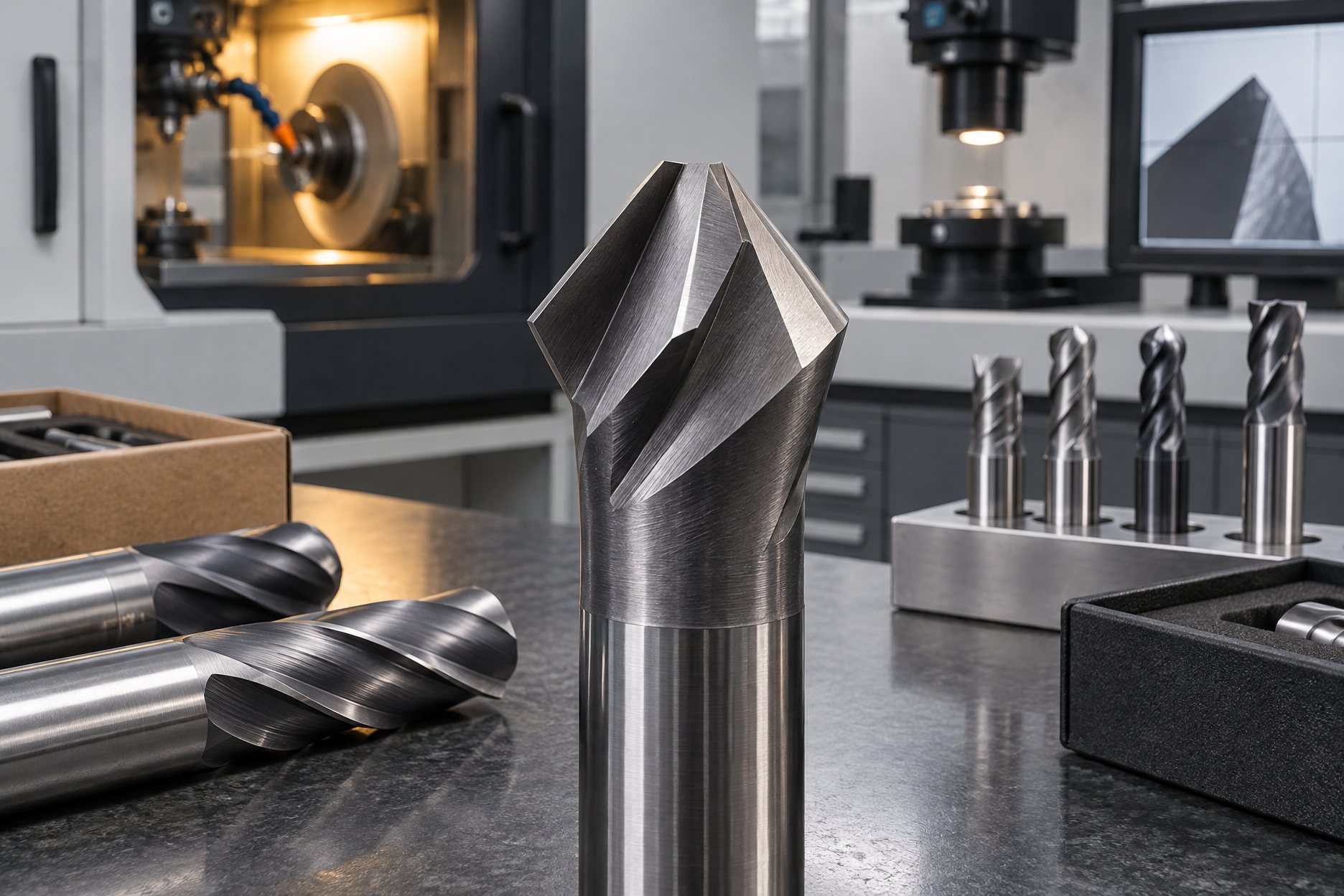
What a chamfer mill is
A chamfer mill is a conical cutting tool: the cutting edges lie on the surface of the cone, so the tool cuts a bevel at the angle it was ground to. Hold it at one angle and it cuts a flat chamfer; run it lightly around an edge and it breaks the sharpness off without changing the part's size. The everyday angle is 45 degrees, and it dominates for a mundane reason - most prints that call a chamfer call 45 degrees, so most stock programs start there. Other angles exist and are carried per spec sheet, because the tool's angle has to match the angle on the drawing exactly; a near-enough cone produces a chamfer that measures wrong, and wrong chamfers are an acceptance argument waiting to happen.
Where it earns its keep
Three jobs fill the chamfer mill's week. Edge breaks: faces and walls come off an end mill sharp enough to cut hands and gouge mating parts, and a light pass with a chamfer mill puts a consistent break along every accessible edge. Deburring hole rims: drilled and milled holes raise a burr on exit, and a chamfer around the rim removes it while giving fasteners a lead-in - which is why the operation often rides along with a threading program. And print chamfers: where the drawing specifies a chamfer as a feature with a dimension, the conical tool cuts it to size in one pass. In countersink work the same conical idea appears - the geometry overlaps, and shops that cut both often buy the two side by side rather than treating them as separate problems.
45 degrees and the other angles
The angle is the spec-sheet headline. 45 degrees covers the majority of edge-break work; other angles serve prints that specify them and specialized operations. The width of the chamfer follows from the angle and how deep the tool feeds - a standard trade relationship, not a number to publish - so a program that needs a wider break at the same angle simply feeds deeper, within the tool's geometry. What matters for a buyer is that the angle on the invoice matches the angle on the prints your customers cut, confirmed per program in writing. Angles of the inverted kind - slots under an overhang - belong to the dovetail cutter family, a different tool for a different profile.
| Tool | Geometry | What it leaves on the edge |
|---|---|---|
| Chamfer mill (this page) | Conical, fixed angle per spec | A flat bevel at the ground angle - 45 degrees and others |
| Corner rounding end mill | Full-radius form profile | A rounded fillet instead of a flat break |
| Square end mill | Sharp 90-degree corners | Nothing - the sharp edge the chamfer pass removes |
| Dovetail cutter | Inverted dovetail profile | A dovetail groove under an overhang |
Flutes, substrate and coating
Chamfering is a light, often interrupted cut out at the extremity of the part, and the tool choices follow the same rules as everywhere else on the site. Fine-grain tungsten carbide is the standard substrate, with HSS variants where toughness and economy lead. Four flutes suit steel and finishing, leaving a cleaner break; higher counts raise feed potential in harder materials; two or three flutes with generous gullets suit aluminum. Coatings follow the workpiece: TiAlN family for steels and dry machining, TiN general purpose, uncoated polished flutes for aluminum, diamond family for abrasive non-ferrous materials. The counts and their trade-offs sit in the flute count guide, the substrate split in the carbide vs HSS note.
Chatter marks, qualitatively
The classic chamfer defect is a wavy break instead of a clean one - chatter, showing up exactly where the part is least supported, at its outer edge. The causes are the usual suspects: an overhang, a light setup, a tool sticking out further than the job needs. The fixes are setup-side - rigidity, engaged length, climb direction - and are covered in the chatter note rather than promised away here. What the sourcing side contributes is a tool ground to the stated angle with a sound edge, so the setup variables are the only variables left.
Standard route or ground to your drawing
Standard chamfer mills in the common angles and diameters ship boxed - commonly ten pieces per box - and are the kind of item distributors reorder by the shelf. The OEM route covers the rest: a non-standard angle your market needs, a combined program with your marking on the shank, your boxes and labels. Standard geometry with your mark starts from about 50 to 100 pieces per specification; special profiles are quoted per tool family against a drawing. Ground-to-order samples take about 15 to 25 days after the drawing is agreed, bulk about 30 to 45 days after approval, coating adding a few days - typical reference ranges, confirmed in writing per program on MOQ and lead time.
What the desk checks before bulk
Chamfer programs are inspected against the approved sample and sheet: optical measurement of the angle and cutting diameter, edge condition under magnification, runout at the cutting edge, coating appearance, marking and packing. A certificate of conformance and material certificates travel with the shipment per program. The full checklist is on the quality control page - the desk's job is that the angle you approved is the angle that arrives.
Send the list
Chamfer programs quote fastest as a line list: angle, cutting diameter, flutes, shank, substrate, coating, quantity per line. Send it through the quote form, or pair it with the adjacent edge-break family under corner rounding if your range carries both.