
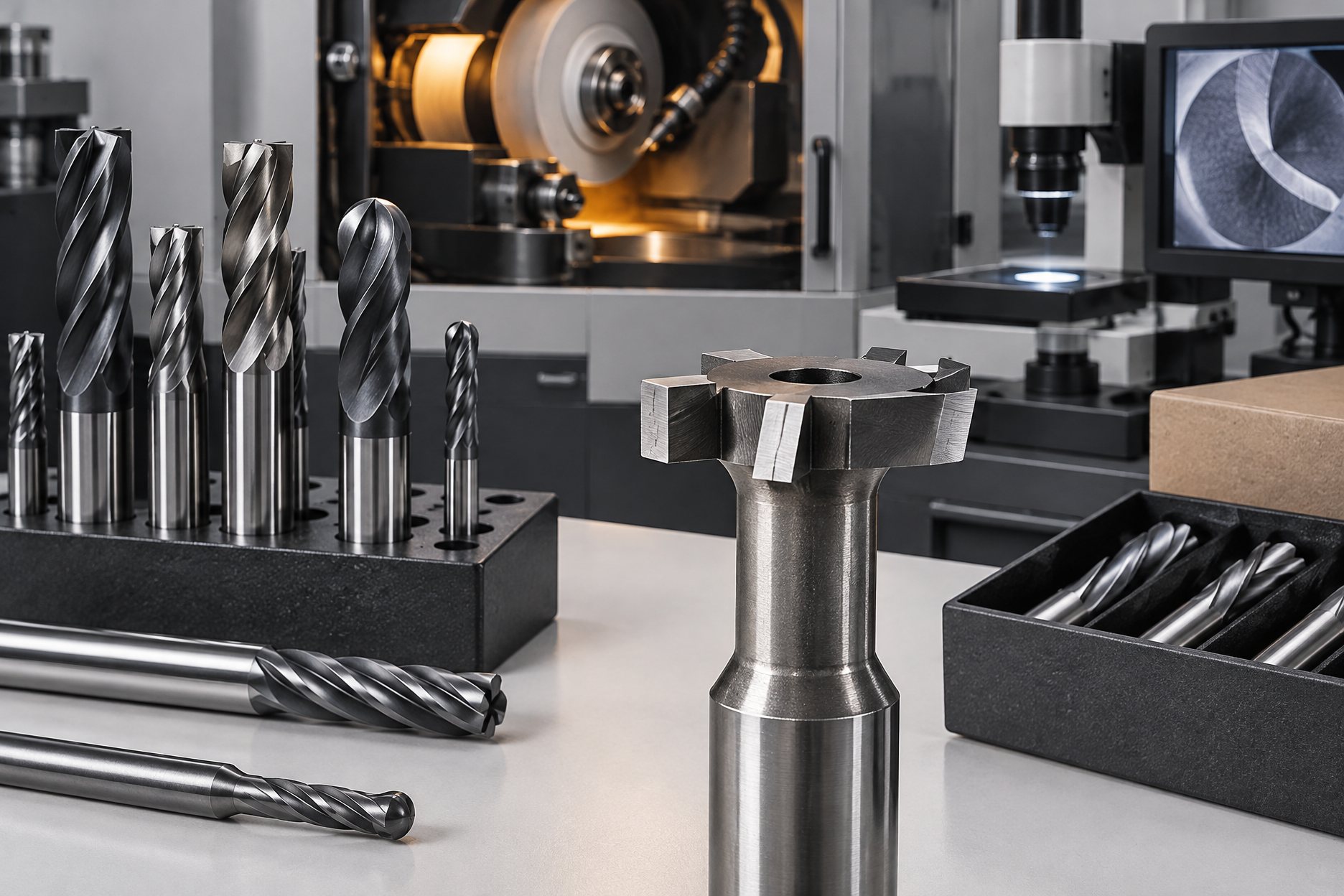
The second pass is the tool
A T-slot is two cuts, not one. First a slotting pass opens the vertical stem - usually a standard slot cut with an end mill or slot drill sized to the neck width. Then the T-slot cutter enters that slot and cuts the crossbar, the wide undercut that gives the T its shape. The cutter is built for the second pass: a narrow neck that fits down the slot, and a blade wider than the neck that sweeps the undercut sideways. Neck width, blade diameter and blade height are therefore the defining lines of the geometry, each confirmed per spec sheet - the three numbers that decide whether the tool fits the slot and cuts the T the drawing calls.
The classic use: machine tables
T-slots exist across the metalworking world as the standard clamping interface: the slots on a milling machine or machining center table that accept T-bolts and studs for workholding. That is the family's classic use and the reason the sizes are standardized - a cutter is bought to match a table standard, and every machine shop owns the tool that maintains its own tables and fixtures. Beyond tables, the same geometry cuts fixture slots for custom workholding, clamp strap channels, and T-shaped features on parts themselves - mold bases, machine builders' components, anywhere a bolt must seat below the surface and slide to clamp.
Choosing blade dimensions against the standard
Because table T-slots follow standards, most cutter choices are lookups: the table size names the slot, the slot names the neck width, and the blade follows the standard crossbar. Fixture work is where judgment returns. A designer may want a wider undercut than any standard, a shallower T to keep a plate thin, or a neck long enough to reach below a recessed face. Those jobs are quoted from the drawing rather than the table, and they are the reason the OEM line exists alongside the standard one. In both cases the arithmetic is the same three numbers - neck, blade diameter, blade height - checked against the feature they must produce.
An undercut is an honest geometry
The undercut makes this family unforgiving in one specific way: chips have one way out, back up the neck through the slot. The blade cuts in a pocket it can barely see out of, so chip packing - not edge strength - is what usually ends a pass early. Practice follows from that: shallower passes with withdrawal to clear, air or coolant aimed at the slot mouth, and blades kept as short as the T allows. Speeds and feeds follow the standard starting-point math and are always adjusted to the machine and setup; the reference lives on the speeds and feeds page. The failure modes are the usual ones - see why tools break - with chip packing at the top of the list for this family.
Flute and edge counts on T-slot cutters are lower than on general end mills by design: the blade needs chip room more than edge count, and the neck constrains how much gullet can be ground. That is one more reason conservative passes win - the geometry trades capacity for the ability to fit the feature at all. What is ground into a given blade, including edge count and clearance angles, is confirmed per spec.
Sequencing and rigidity
The slotting pass sets up everything. Its width is the neck's clearance, its depth positions the crossbar, and any wander shows up in the undercut. Most shops cut the stem with a square tool sized to the standard slot width - the square end mill or slot drill drawer - then finish with the T-slot cutter in a second tool. Rigidity matters at both steps: the T-slot cutter works at the end of its neck, the most compliant part of the tool, so short necks where the T allows and conservative passes where it does not are the practical rule. HSS-Co remains a common substrate for table maintenance work where shock is likely; solid carbide carries fixture work where stiffness leads. Substrate and coating are spec-sheet lines, confirmed per program.
What the spec sheet names
| Line | What it decides |
|---|---|
| Neck width | The slot the tool reaches through; matched to the slotting pass |
| Blade diameter | The T width - the undercut's span |
| Blade height | The T's thickness, top to bottom |
| Neck length | How deep below the surface the crossbar sits |
| Shank / OAL | Holder fit and reach |
| Substrate / coating | HSS-Co or carbide; TiAlN family, TiN, uncoated per material |
Each line is confirmed per spec sheet, and a T-slot program is only quotable when the slot standard - table size or drawing - is on the sheet beside it.
Standard sizes and custom Ts
The standard route covers the common table standards: boxed tools quoted per line item, often ten pieces per box, shipped in days. Custom T-slots - a fixture designer's non-standard crossbar, a machine builder's own slot family - go the OEM route with a drawing, from quantities around 50 to 100 pieces per specification, samples about 15 to 25 days after the drawing is agreed, bulk about 30 to 45 days after approval. Those are reference ranges, confirmed in writing per program; the table lives on the MOQ and lead time page. Send the slot standard or the drawing with the quote form, and the first reply will say which route the program takes and what is still open.