
The resale math comes first
Wholesale buyers do not ask which end mill is universally superior in the abstract; they ask which programs turn. A distributor's counter sells what the local shops cut. An online store sells what its listings rank for. An industrial supplier sells what the maintenance department down the street keeps reordering. So this page is organized the way a stock program is actually built: what the boxes look like, what to stock first, how reorders run, how shipments can mix, and when private label starts to make sense. Geometry science lives on the family pages; this page is about the box, the rhythm and the range.
Boxed stock programs
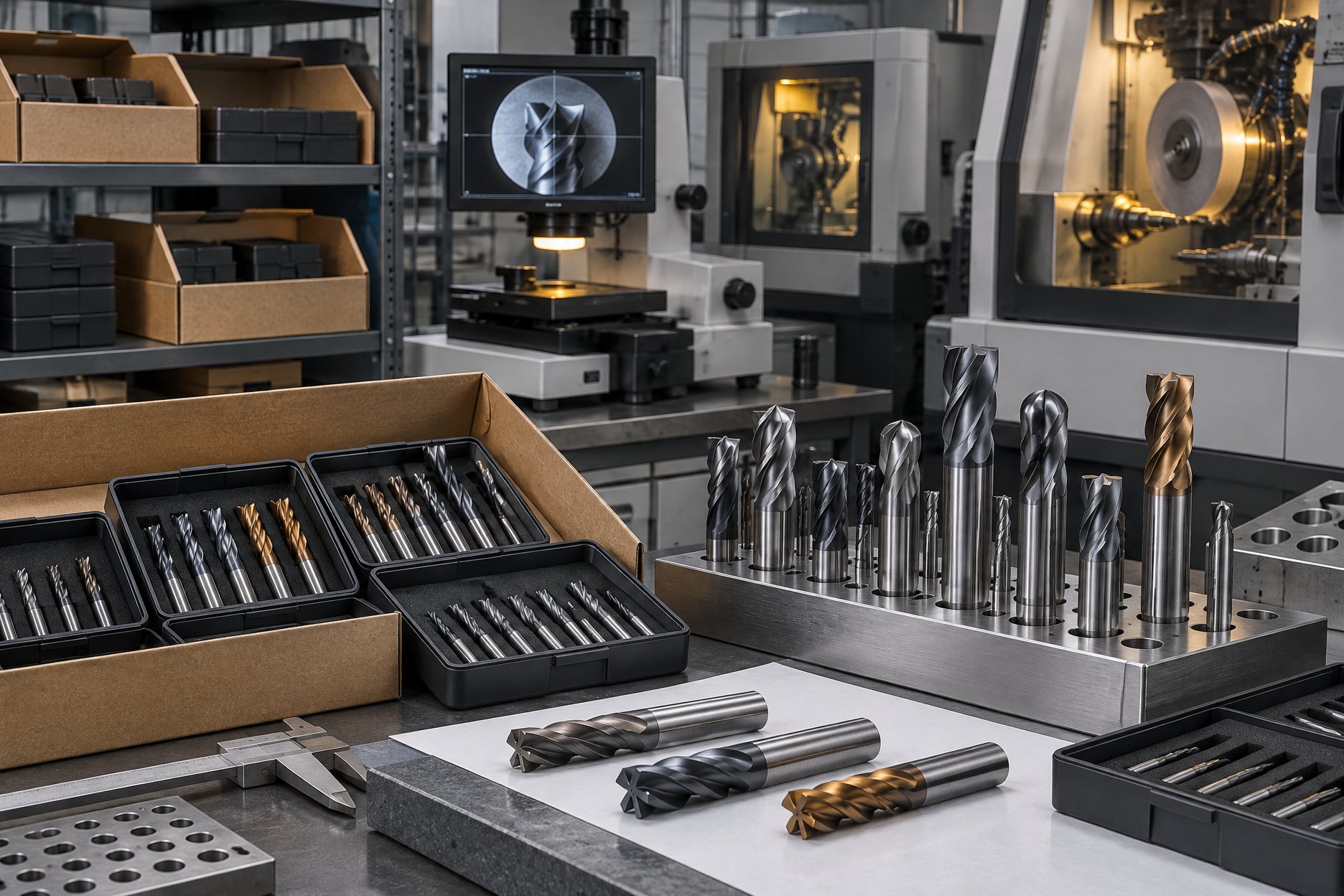
End mills ship boxed - commonly ten pieces per box, one geometry per box - with the geometry called out on the label. Boxes are the natural resale unit: a counter sells a box, a web store lists a box, a maintenance department buys a box and opens it as needed. Small lots are fine on the standard route; there is no requirement to start with a pallet. Stock items ship in days, which is what makes a stock program different from a ground-to-order program: you are buying tools that already exist, in reference geometry, ready to relabel and resell. The reference quantities sit on the MOQ and lead time page alongside the OEM figures, so both routes can be planned from one table.
What to stock first
Assortments that last tend to start narrow and deep rather than wide and thin. A core set for general metalwork: square end mills in the common diameter range in two and four flutes, ball nose for contour work, roughing end mills for heavy removal. From there, branch by customer: aluminum work calls for the polished-flute selections, steel work for coated four-flute lines, maintenance counters for slot drills and chamfer mills. Diameter logic and the inch-metric split are laid out on the sizes reference - worth reading before the first order, because a mixed assortment is quoted line by line, and every line is a box you will either turn or shelve. The substrate split is a decision too: solid carbide for CNC-facing assortments, HSS where your customers run older machines and hand-held work.
Reorder rhythm
A stock program is a rhythm, not a transaction. The first order teaches you what turns; the second one is placed against evidence. Sellers who plan reorders around sell-through - rather than around running out - keep the counter full without tying cash into dust-collecting sizes. The desk supports that with a simple loop: your sell-through list becomes the next quotation, quantities and lead time confirmed in writing, stock items shipping in days. The loop works the same for a two-hundred-box distributor and a twenty-box online store; only the numbers move. The planning logic is written up in the reorder planning note; the ranges behind each step sit on the MOQ page linked above.
Mixed programs across geometries
One shipment does not have to be one geometry. A program can mix square, ball nose, roughing and slot drills - carbide and HSS, coated and uncoated - into a single packed order, line by line against the spec sheet. Mixing has two practical limits, both handled on the sheet: packing (boxes stay one geometry per box, cartons are packed per the program sheet) and confirmation (the mixed list is confirmed in writing before picking, so the carton contents match the invoice). For online sellers, mixed shipments also mean related listings can launch together instead of staggering across three separate orders and three freight events.
The private label conversion path
Most resale programs start with neutral boxes: your customers see the geometry label, not a manufacturer's mark. That is deliberate - it leaves the door open. When a line proves itself, convert it: your logo laser-marked on the shank, your name on the boxes, printed for your market. Conversion happens per line item, typically from about 50 to 100 pieces per specification for standard geometry, so you can take your best-turning two or three geometries private-label first and leave the long tail neutral. The mechanics - marking, boxes, labels, artwork approval - are on the private label page, and reading a finished label is covered in the packaging labels note.
Niche sellers, same desk
Two resale segments deserve their own line. Online tooling stores live and die by listing quality: the desk supplies the geometry data behind each box so listings can be specific - flutes, helix, coating family, sizes - and specific listings answer the questions buyers actually type, which returns fewer mismatches and fewer returns. Education and maker programs buy by class set: assortments sized for a bench, boxed so a term's worth of wear can be replaced line by line instead of re-buying a whole kit. Both are quoted the same way as any other stock program, from the sheet, in writing.
How a stock program is quoted
Quotation follows the spec sheet, per program: geometry families, substrate, coating, quantity per line and packing. Price is never published on this site - it is quoted per program in writing - and the desk's reference ranges (boxed quantities, lead times, conversion quantities) are the same ones printed on the MOQ page, so you can plan before you ask. Send the assortment you have in mind through the quote form, even if it is five lines long; the reply names what ships from stock in days, what grinds to order, and what is worth adding to the range before your customers ask for it. If the list is still a guess, say so - a first range built to be tested beats a deep one built to impress.