
Illustrative, and labeled as such
Four program shapes cover most of what arrives at the desk, and this page walks each one: who the buyer is, what the program contains, and where the decisions sit. To be plain about status: these are illustrative composites, not a client record. No client names appear, no invented results are attached, and no figures beyond the site's standing reference ranges are used - because a real program's numbers belong to the buyer who set them. What the cases are good for is shape: seeing where your own brief lands, which lines on the spec sheet will matter first, and which questions the desk will ask before quoting.
Case one: a tool brand launches a square end mill line
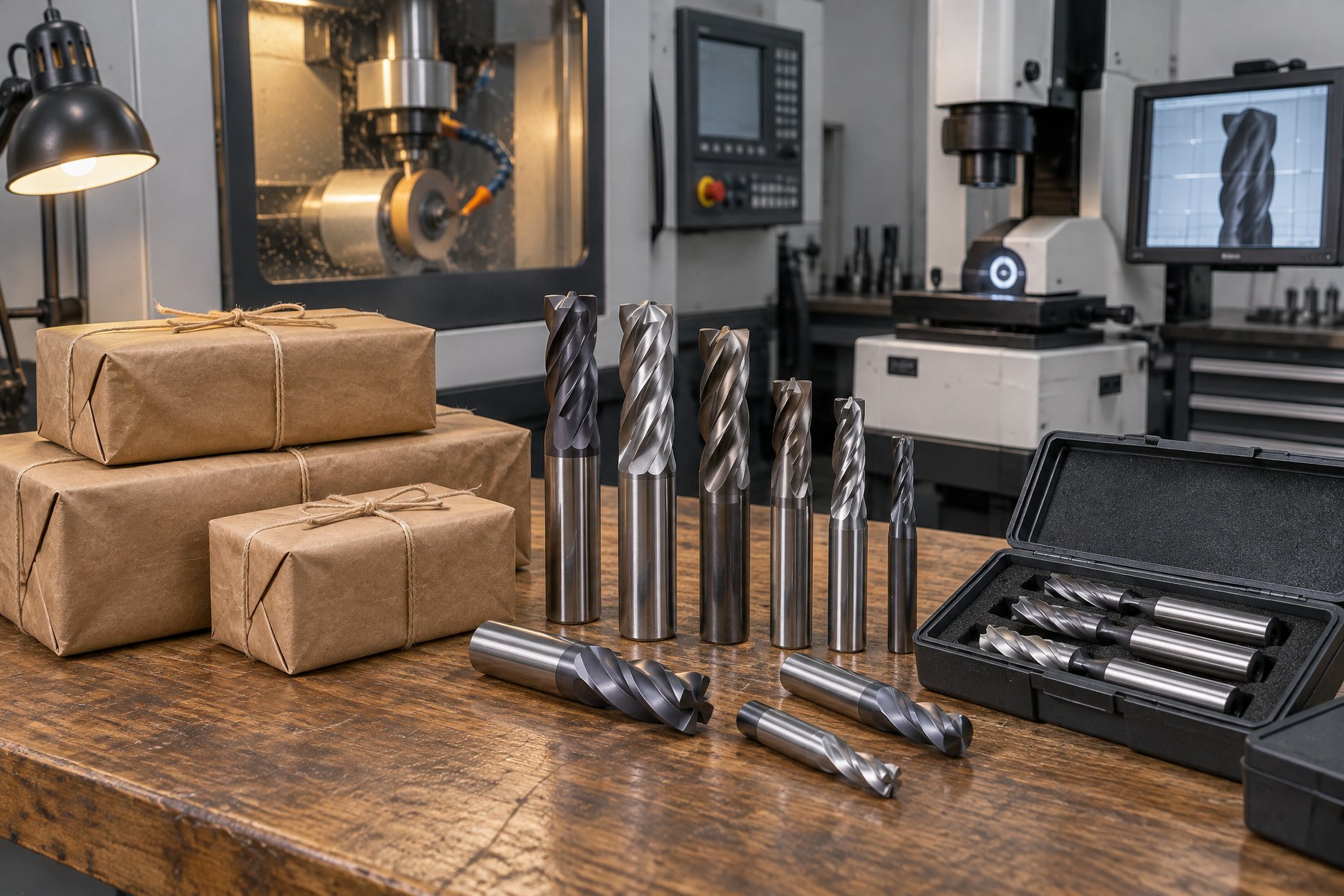
A cutting-tool brand with a catalog of drills wants to answer the end mill question its customers keep asking. The program: a square end mill line under the brand's own name - a tight set of common diameters, four flutes for steel work, TiAlN-family coating, the brand's logo laser-marked on the shank, branded boxes with geometry labels. The decisions that matter: how many diameters make a credible first module (fewer than the brand expects, usually - a line that reorders beats a wall of stock), neutral-sample validation of the geometry before anything carries the logo, and box design locked early because print quantities per design are a real line on the quote. This is the private label route at its most standard: proven geometry, your mark, quantities from about 50-100 pcs per specification, confirmed in writing per program.
Case two: a job shop needs a special taper
A CNC job shop is quoting a mold repair job whose cavity calls for a taper profile the catalog does not carry - a specific taper angle with a ball end, and a reach that rules out standard sticks. The program: a non-standard geometry ground to drawing, substrate and coating matched to the workpiece, samples first because the tool has to prove itself in the actual material. The decisions that matter: the drawing (complete enough to quote - every geometry line, tolerances, substrate, coating), the quantity per specification, and a regrind conversation from the start, because a special profile that earns its keep once will be needed again, and a tool with a documented geometry is a tool that can be restored. This is the ground-to-order route - the drawing requirements and timing are on the custom grinding page and the geometry family on tapered end mills.
Case three: a distributor's core stock program
An industrial distributor wants dependable depth on the movers - the square, ball nose and roughing items that walk out the counter - without tying up capital in slow tails. The program: a core stock program in standard geometry, boxed the way the trade packs end mills - commonly ten pieces to a box - with a replenishment rhythm instead of one-off orders. The decisions that matter: which diameters earn core status (sales data settles it faster than opinion), how many boxes per reorder keeps freight sane, and a reorder plan tied to actual draw-down rather than calendar optimism. Nothing exotic in the geometry; the value is in the rhythm and the written spec sheet that makes every batch match the last. This is the standard route - the desk's wholesale framing is on wholesale supply, and the planning logic in the reorder planning note.
Case four: a reseller's mixed starter program
An online tooling seller wants to open a milling category with a broad, shallow range: a bit of everything that a search brings buyers to - square, ball nose, chamfer, corner rounding - in retail-grade boxes with clean labels, at quantities that do not require a warehouse. The program: a mixed-geometry starter set across families, standard reference geometry, one coating family for simplicity, retail packing per family. The decisions that matter: depth-per-item discipline (wide and shallow, with the depth earned by what sells), labeling that survives marketplace listing requirements, and a path to promote winners into a deeper second round - the same conversion logic a brand uses, at reseller scale. The family picker lives on the geometry index, and the flagship family on square end mills.
The four programs side by side
| Case | Buyer | Program shape | Route |
|---|---|---|---|
| 1 | Tool brand | Private-label square end mill module, own boxes | OEM marking on standard geometry |
| 2 | Job shop | Special taper to drawing, samples first | OEM, non-standard geometry |
| 3 | Distributor | Core stock in movers, boxed, replenished | Standard catalog |
| 4 | Reseller | Mixed-geometry starter range, retail packing | Standard catalog |
The table's point is that route follows buyer, not fashion: brands and specials run the OEM lane, stock and starters run the standard lane, and mixed programs can run both at once with one packing point at the end. Reference quantities and timing for either lane sit in one table on the MOQ and lead time page.
What is never in a case
No client names, no invented test results, no revenue stories. A case on this page is a program shape - buyer type, geometry, route, decisions - and nothing else. When a real program runs, its results belong to the buyer, and the desk's evidence is the paperwork the buyer holds: the spec sheet, the approved sample, the inspection results and the certificates that traveled with the shipment. If you need confidence before committing, the honest instruments are a factory profile on request and a sample you test on your own machine, not a testimonial.
Which one is yours?
Most briefs land inside one of the four shapes, and the desk's first reply says which, with a module proposal, a sampling plan and the open questions. Send the range or the drawing through the quote form - the closer your brief is to one of these shapes, the faster the first written answer comes back.